
Cosmetic label requirements: FDA, INCI & MoCRA basics
A cosmetic label looks simple, but it sits on top of a real regulatory framework: the FD&C Act, the Fair Packaging and Labeling Act, and now MoCRA. Here is a plain-language tour of what a US cosmetic label has to carry, and why the small stuff is the hard part.
THE SHORT ANSWER
Pick gloss, matte or soft-touch laminate, then price it. A US cosmetic label must generally identify the product, state the net quantity, declare its ingredients by common or usual names, name the responsible company, and carry any required warnings under the Federal Food, Drug, and Cosmetic Act and the Fair Packaging and Labeling Act, with MoCRA layering newer obligations on top. The essentials:
- Identity + net quantity go on the front (the principal display panel)
- Ingredients are listed by the applicable US ingredient name, generally in descending order of predominance
- Responsible-party name and address, plus any required warnings, must also appear
- MoCRA adds facility registration, product listing, and other duties on top of the older rules
- This is general information, not legal advice. Verify current rules with the FDA
A cosmetic label carries more than a brand. It is a small, regulated document: it has to say what the product is, how much is inside, what is in it, who stands behind it, and how to use it safely. In the US that is overseen by the FDA under the Federal Food, Drug, and Cosmetic Act (the FD&C Act) and the Fair Packaging and Labeling Act (FPLA), and it is being modernized by MoCRA. This guide is a plain-language tour for the people who design the pack, and part of our complete guide to beauty & cosmetic packaging.
Not legal or regulatory advice. This article is a plain-language overview for people designing cosmetic packaging, not compliance guidance. US cosmetic rules are set by the FDA and are actively changing under MoCRA, and the details differ by product type and by market. Confirm what applies to your product with the FDA and qualified counsel before you print, and re-check periodically, because the rules change.
Pick the laminate
Our core finishes are gloss, matte and soft-touch laminates over BOPP film. Spot UV and raised tactile varnish add a targeted effect and price instantly too. Foil and embossing are quoted by our team.
Finish picker
The same label in gloss, matte and soft touch
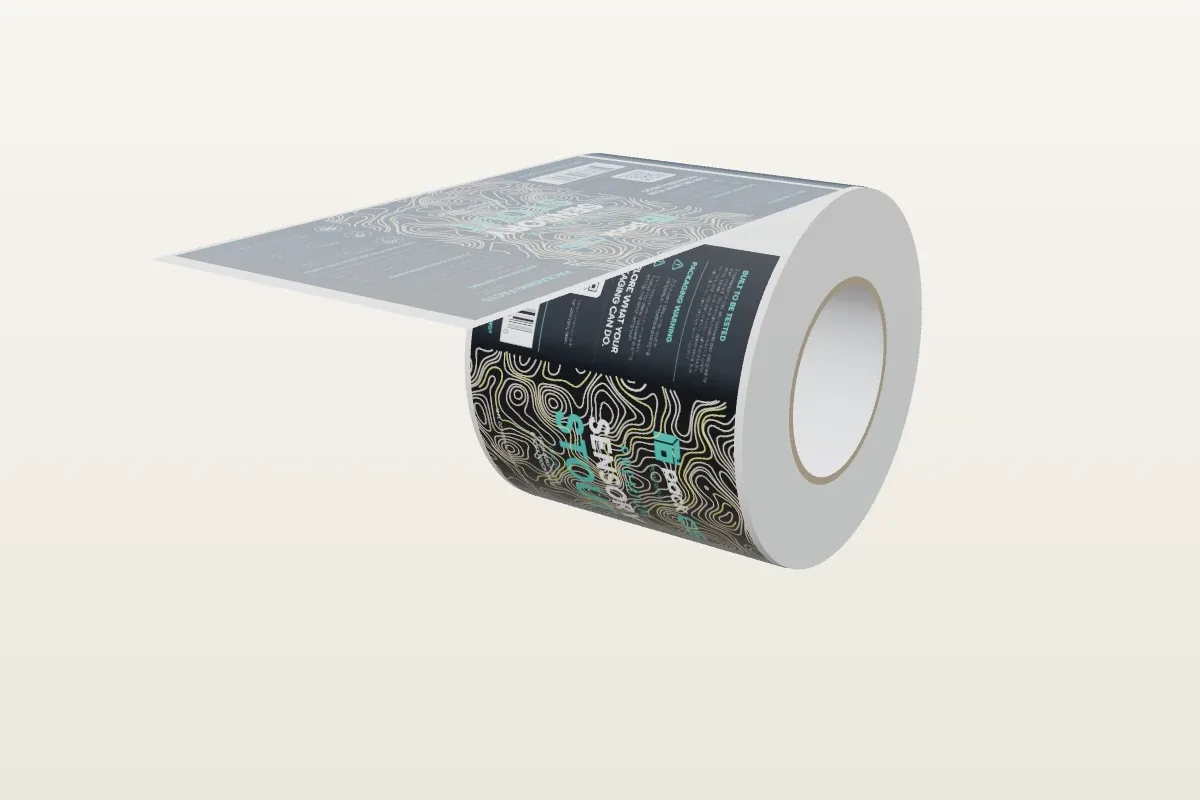
Gloss laminate
A clear, shiny film over the print. Colors look deeper and the surface reflects light, so highlights run across the label as it turns. Fingerprints and scuffs show more than on matte.
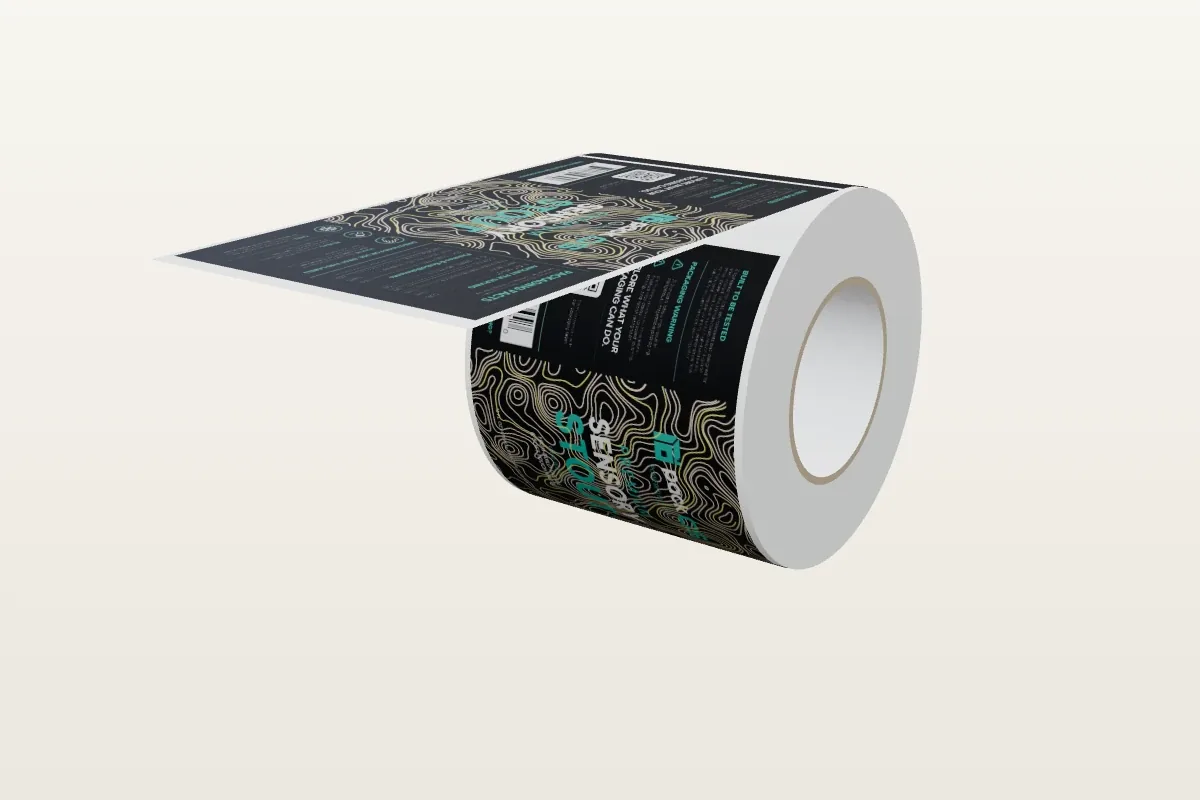
Matte laminate
A flat, non-reflective film. Softer color and no glare under shelf lighting. Often chosen for a premium, understated look.
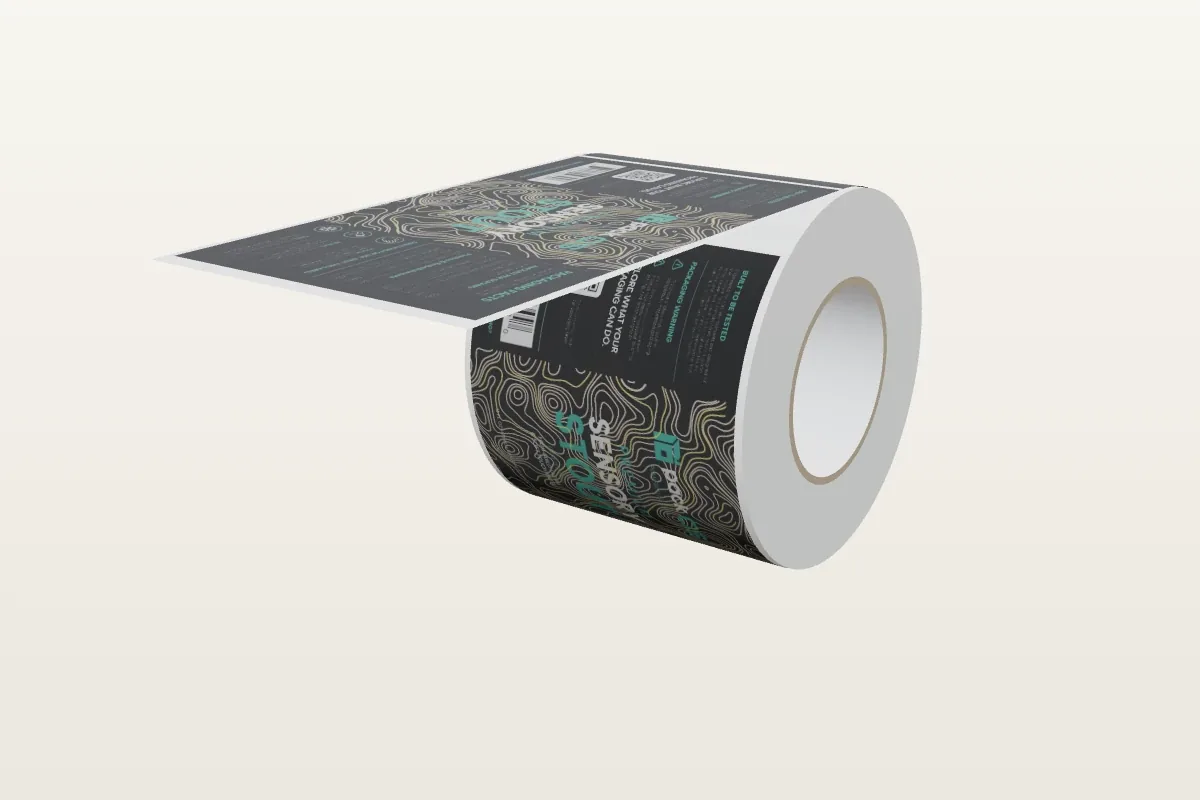
Soft-touch laminate
A velvet matte film with a suede feel in the hand. Muted and soft to the eye, and the finish people pick up to touch.
All three are priced instantly, as are spot UV and raised tactile varnish. Foil, embossing and debossing are quoted by our team.
Why start in PackOS
Once you know the details, see the price, the dieline and your label on a roll in one place.
From file to price in PackOS
What you get in PackOS
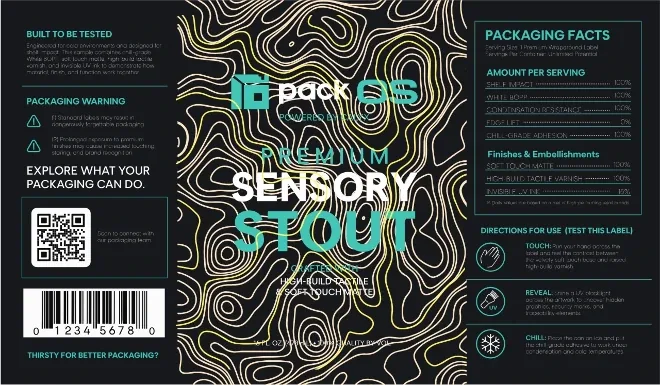
Skip the spec form
Upload a PDF or AI file and PackOS reads the size, shape, colors and finishes from your design. Nothing to retype.
Upload artwork →Instant price · sample label
| Run | Per label | Total |
|---|---|---|
| 10,000 | $0.1996 | $2,346 |
| 60,000 | $0.1692 | $10,500 |
| 110,000 | $0.1670 | $18,722 |
| 150,000 | $0.1663 | $25,290 |
| 200,000 | $0.1658 | $33,500 |
| 250,000 | $0.1655 | $41,725 |
Know the price before you ask
Every quantity is priced as soon as the file is read, with no waiting on a quote. Runs start at 10,000 labels per size with at least 2,500 per SKU. Your price depends on your artwork. Order online; the proof and a payment link follow by email.
Get instant label pricing →
Get a production dieline
No artwork yet? Draw the die with cut, bleed and safe-area lines so your designer starts from the right shape. We email it with your quote.
Create a label dieline →
See it on the roll first
Turn your label on a 3D roll in the copy position you choose and check it before you order.
Upload artwork →Labels only. Foil, embossing and other specialty work are quoted by our team.
How US cosmetic labeling is regulated
Two long-standing laws do most of the work. The FD&C Act is the FDA's core authority over cosmetics; among other things it makes a product "misbranded" if its labeling is false or misleading or if required information is missing. The Fair Packaging and Labeling Act governs how consumer commodities (cosmetics included) are labeled for retail sale, and it is where several of the familiar requirements come from, including the ingredient declaration on products sold to consumers.
On top of those sits MoCRA, the Modernization of Cosmetics Regulation Act, the most significant update to US cosmetics law in a long time. MoCRA does not throw out the older framework; it adds to it, with new obligations for companies and new rulemaking that will touch labels over time. The practical takeaway: a compliant label today follows the FD&C Act and FPLA, and a compliant company increasingly has to satisfy MoCRA as well. Because MoCRA is still being implemented, treat any specific timeline you read about as provisional and check the FDA for the current position.
Beauty labels
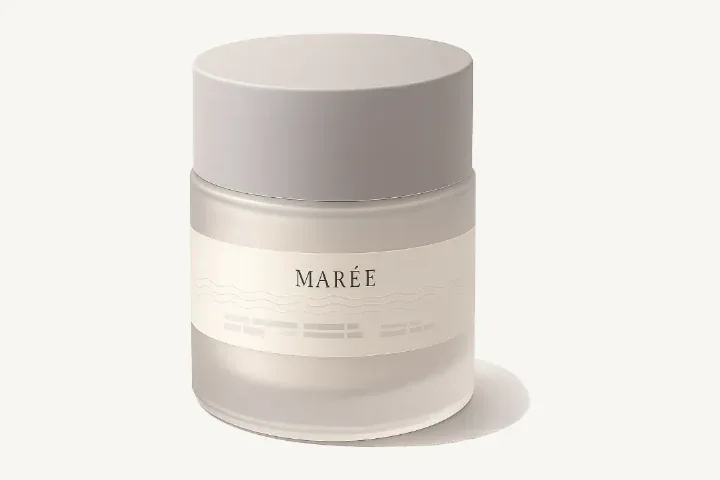
Labels for jars, tubes and bottles
See the materials and finishes we print for beauty and personal care brands, priced instantly online.
See beauty labels →The label elements every cosmetic needs
Set the newer obligations aside for a moment and look at the label itself. A retail cosmetic in the US is generally expected to carry a short, predictable set of elements. Regulations divide the label into a principal display panel (the part the shopper sees first) and an information panel (typically the back or side), and they place specific elements on each. The specific type sizes, placement, and prominence are set by regulation and change over time, so treat the table below as a map of what is required, not the formatting spec.
| Element | What it covers | Typically goes |
|---|---|---|
| Statement of identity | What the product is: its common name or its function (for example, "moisturizing cream") | Principal display panel (front) |
| Net quantity of contents | How much is inside, by weight or volume | Principal display panel (front) |
| Ingredient declaration | Every ingredient, generally by the applicable US ingredient name, in descending order of predominance | Information panel (back or side) |
| Responsible-party information | Name and place of business of the manufacturer, packer, or distributor | Information panel |
| Warnings and cautions | Any statements needed for safe use of that product type | Wherever they are conspicuous |
| Directions for safe use | How to use the product safely, where relevant | Information panel |
Every one of those has nuance (how "conspicuous" is defined, when a warning is triggered, how net quantity is expressed), and that nuance is exactly what the regulations spell out. The point of the table is to make sure nothing is simply forgotten when the artwork goes to layout, because a missing required element is one of the classic ways a label becomes misbranded.
INCI: how cosmetic ingredients are named
INCI is a useful reference, but US retail labels require applicable common or usual names. FDA does not accept Latin-only botanical names, CI numbers alone, Aqua or Parfum as substitutes for the required US names. See FDA ingredient-name guidance.
A few conventions matter when you lay out the list:
- Ingredients are generally listed in descending order of predominance, most first.
- There are special conventions for ingredients present at low concentrations (generally around one percent or less) and for color additives, which are often grouped at the end.
- Fragrance and flavor are commonly declared with grouped terms rather than their full component breakdown, though MoCRA is set to change how certain fragrance allergens are disclosed, so watch that space.
Have the responsible reviewer approve the ingredient names and order before artwork release. Keep that approved text with the formula revision and destination market.
Laying out a beauty or personal-care label? See how we print labels for these brands.
See beauty labels →MoCRA: the newer layer of rules
MoCRA, enacted in 2022, is the biggest modernization of US cosmetics oversight in decades. Most of it is about company obligations rather than the literal words on a label, but designers should understand it because it changes what a "compliant product" means. One of its requirements already reaches the label: since 29 December 2024, each cosmetic label must include a domestic address, domestic phone number or electronic contact through which the responsible person can receive adverse-event reports. More rulemaking is still pending. Broadly, MoCRA introduces:
- Facility registration and product listing: registering the places that make cosmetics and listing the products and their ingredients with the FDA.
- A responsible person and adverse-event reporting: a named party accountable for the product, with a duty to report certain serious adverse events.
- Safety substantiation: keeping records that support a product's safety.
- Recall authority and pending rules: FDA mandatory recall authority is already in force. Fragrance-allergen labeling and Good Manufacturing Practices rules were still pending at our last check, so confirm their status with the FDA.
Registration: under MoCRA, the requirement for cosmetic manufacturing and processing facilities to register with the FDA, paired with a product listing for each cosmetic. See more terms in the packaging glossary.
MoCRA also contains exemptions for some small businesses from certain requirements, but not all of them, and whether an exemption applies depends on the specifics. Because compliance dates have shifted during implementation, do not treat any single deadline as settled; check the FDA for the current schedule and confirm which obligations apply to your business.
Have your artwork? See the price for every quantity in seconds.
Get instant label pricing →Cosmetic or drug? Why claims decide
Here is the trap that catches ambitious brands. Whether a product is a cosmetic or a drug in the US is not decided by the formula alone. It is decided by intended use, and intended use is shown mostly through the claims you make. A product meant only to cleanse or beautify is a cosmetic. A product meant to treat or prevent disease, or to affect the structure or function of the body, is a drug, and drugs carry a heavier labeling burden, including Drug Facts labeling and active-ingredient rules.
Plenty of familiar products are legally both (a cosmetic and a drug at once) and must meet the drug requirements too. Common examples include:
- Sunscreens
- Anti-dandruff shampoos
- Antiperspirants (as distinct from plain deodorants)
- Fluoride toothpastes
- Acne treatments
READS AS A COSMETIC CLAIM
- Meant only to cleanse or beautify
- "Reduces the appearance of fine lines"
TIPS TOWARD A DRUG CLAIM
- Meant to treat or prevent disease, or affect the structure or function of the body
- "Repairs", "heals" or "treats"
- Heavier labeling burden, including Drug Facts
The wording is the tell. This is a genuinely gray area, it is general information rather than a ruling on your specific copy, and it is worth a conversation with counsel before you commit expensive artwork. Separately, environmental claims are covered by the FTC's Green Guides, and other marketing words such as "clean" or "natural" must still be truthful and substantiated under FTC law. If your label leans on sustainability messaging, read our sustainable packaging guide and keep those claims honest and substantiated.
Small packages: fitting everything on
Labeling cosmetics? Start with the cosmetic label page.
Cosmetic labels →Beauty is full of tiny packages (a 5 ml serum, a lip balm, a sample vial), and small formats are where labeling gets genuinely hard, because all the required information still has to be present and legible.
The FDA recognizes this and, in certain situations, allows some information to be presented off the immediate container (for example on a firmly affixed tag, tape, or card, or on accompanying material at the point of sale). Those allowances are narrow and specific, so treat them as a last resort, not a default.
Most of the time the answer is disciplined design, not off-pack disclosure. That means planning the dieline, the bleed, and the smallest safe type size up front (see our guide to label dieline and bleed specs) and choosing a label material and finish that keeps small type crisp, which our label materials guide gets into. The container itself sets the constraint too: a curved skincare bottle, a squeeze tube, and a wide-mouth jar each give you a different amount of flat, readable real estate.
A practical order of operations for a tight cosmetic label:
- Confirm what appliesConfirm which elements actually apply to your specific product.
- Map the frontMap the statement of identity and net quantity to the principal display panel.
- Lay out the backLay out the ingredient declaration and responsible-party information on the information panel.
- Check legibilityCheck type legibility and place any required warnings conspicuously.
- Off-pack if forcedOnly if space truly forces it, consider a permitted off-pack disclosure.
- VerifyVerify the whole thing against the current FDA rules and your target market.
Instant label pricing
Upload your artwork and see the price
Drop in a PDF or AI file. PackOS reads the size, shape and colors and prices it from 10,000 labels per size.
Upload artwork →Where PackOS fits: printing the compliant label
PackOS does not decide whether your copy makes a drug claim or whether a MoCRA exemption applies. Those are calls for you and your counsel. Once the content is settled, PackOS prices the label: upload the artwork to Quick Quote, review the detected attributes (size, colors and finish callouts) and confirm the specification. Supported materials and finishes price instantly; foil, embossing and other specialty work is quoted by our team. Keep small type legible and approve the proof before production. See how we print labels for the beauty and personal-care brands we work with.
Frequently asked questions
Are cosmetic ingredients required on the label?
Generally yes. For cosmetics sold at retail in the United States, the ingredient declaration is required, and ingredients are listed by common or usual names in descending order of predominance. Some very small packages qualify for off-pack disclosure, and the rules can change, so confirm the current FDA requirement for your product.
What is INCI on a cosmetic label?
INCI is an ingredient nomenclature system. For US retail labels, check FDA naming requirements; an international ingredient name is not automatically an acceptable US declaration.
Does MoCRA replace the older FDA cosmetic rules?
No. MoCRA, the Modernization of Cosmetics Regulation Act, adds to the existing framework rather than replacing it. Labels still follow the Federal Food, Drug, and Cosmetic Act and the Fair Packaging and Labeling Act, and MoCRA layers on newer obligations such as facility registration and product listing. Verify the current requirements with the FDA.
When is a product a cosmetic versus a drug?
It depends on the intended use shown by the product's claims. Something meant only to cleanse or beautify is a cosmetic, while something meant to treat or prevent disease or to affect the body's structure or function is a drug. Some products are both and must meet drug requirements as well. This is general information, not legal advice.
Can I fit all the required information on a small cosmetic package?
Often yes, but small packages are the hardest case. The FDA allows some information to be presented off the immediate container in certain situations, and careful dieline, type-size, and layout planning helps the rest fit. Confirm what applies to your product and market before you finalize artwork.