
Shrink sleeve labels: full 360° decoration explained
A shrink sleeve turns a bottle, jar, or can into a full-color billboard. Graphics wrap the entire container, corner to corner, in a way a flat label never can. Here's how sleeves work, the films they're made from, and when they're the right call.
THE SHORT ANSWER
A shrink sleeve label is a printed plastic tube that slides over a container and shrinks to its exact shape under heat, decorating the full body in 360°, edge-to-edge graphics. Unlike a flat label, it follows tapers and compound curves, and the same sleeve can double as a tamper band or neck band. The trade-offs come down to film choice, application equipment, and recyclability.
- Full coverage: wraps the whole container, including shapes a flat label can't follow
- Built-in extras: one sleeve can form a tamper-evident band or a neck band
- Film matters: PET-G, OPS, and PLA differ in shrink, feel, and recyclability
- The recyclability catch: a full-body sleeve can complicate recycling unless it's designed for it
- vs pressure-sensitive: sleeves win on coverage and shape; PS labels win on simplicity and cost
PackOS prints pressure-sensitive roll labels, not sleeves. Use the picker below to see whether a label can do the job, and price it instantly if it can.
Sleeve or pressure-sensitive label?
Many containers that get sleeved could take a pressure-sensitive label instead. Pick what your container needs to see which one fits.
Sleeve or label?
What does your container need?
A wrap or front and back label
Straight or gently curved sides take a pressure-sensitive wrap or a front and back pair. White or clear BOPP with a gloss, matte or soft-touch laminate is our core build.
Squeeze BOPP
A film made to flex with squeezable PE bottles and tubes. Confirm the fit on your container with a finished-label trial.
Beverage White with CHILL adhesive
For cold, damp application and the condensation that forms as a chilled product warms. Agree the trial conditions with your filling line.
Silver or holographic BOPP
Leave ink off where you want the metal or the rainbow to show through. Finish it with a gloss, matte or soft-touch laminate.
Full 360° coverage over curves
If a tapered panel is enough, a tapered pressure-sensitive label prices instantly. Edge-to-edge coverage over compound curves is a sleeve job, and PackOS does not make sleeves.
Tamper and neck bands
Shrink tamper bands and neck bands come from a sleeve converter. PackOS does not make them. Your pressure-sensitive body label can still be priced here.
PackOS prints pressure-sensitive roll labels. It does not quote or apply shrink sleeves.
Why start in PackOS
If a label does the job, see the price, the dieline and your label on a roll in one place.
From file to price in PackOS
What you get in PackOS
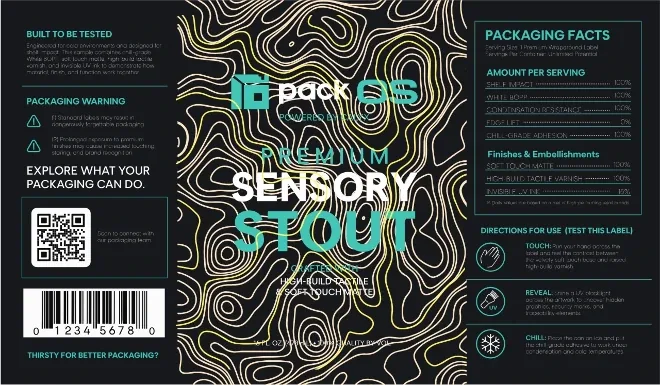
Skip the spec form
Upload a PDF or AI file and PackOS reads the size, shape, colors and finishes from your design. Nothing to retype.
Upload artwork →Instant price · sample label
| Run | Per label | Total |
|---|---|---|
| 10,000 | $0.1996 | $2,346 |
| 60,000 | $0.1692 | $10,500 |
| 110,000 | $0.1670 | $18,722 |
| 150,000 | $0.1663 | $25,290 |
| 200,000 | $0.1658 | $33,500 |
| 250,000 | $0.1655 | $41,725 |
Know the price before you ask
Every quantity is priced as soon as the file is read, with no waiting on a quote. Runs start at 10,000 labels per size with at least 2,500 per SKU. Your price depends on your artwork. Order online; the proof and a payment link follow by email.
Get instant label pricing →
Get a production dieline
No artwork yet? Draw the die with cut, bleed and safe-area lines so your designer starts from the right shape. We email it with your quote.
Create a label dieline →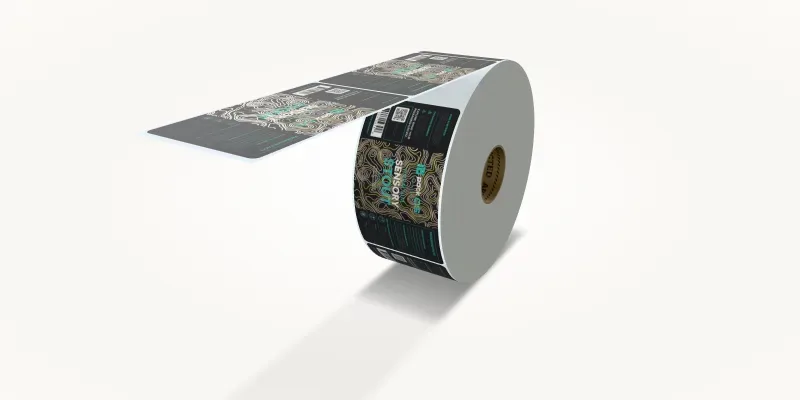
See it on the roll first
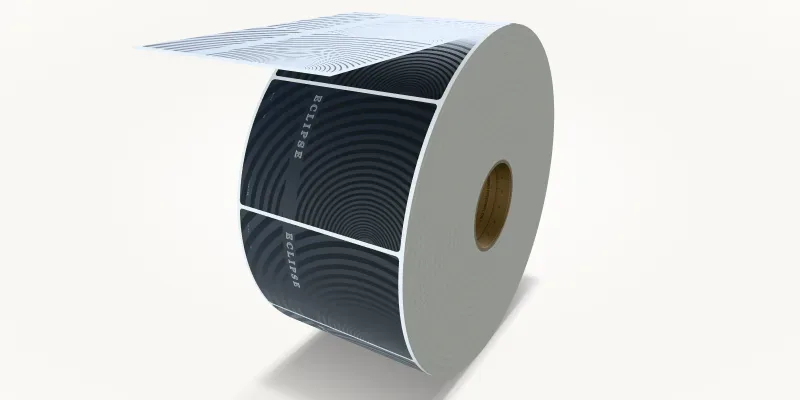
Turn your label on a 3D roll in the copy position you choose and check it before you order.
Upload artwork →Labels only. Foil, embossing and other specialty work are quoted by our team.
What a shrink sleeve label actually is
A shrink sleeve is a printed film tube that starts life larger than the container it will decorate. It arrives at the packaging line as a flat roll of seamed tubing. The film is printed, then folded and welded into a continuous tube called the layflat. A machine cuts the tube to length, opens it, and drops it over the bottle or jar. Heat does the rest: as the sleeve passes through a tunnel, the film contracts and grips the container's contours until it looks printed directly onto the surface.
Because the sleeve wraps the whole body, it delivers something a flat label can't: continuous 360°, edge-to-edge graphics with no visible label edge to lift or peel. The film is usually reverse-printed: the ink sits on the inside face, sandwiched between the film and the container, so the graphics are protected from scuffing and the finished piece has a glassy shine. This guide is part of our complete guide to label printing, and the sleeve is the most graphics-forward option in the whole family.
Sleeves also do double duty. Run one up over the cap and perforate it, and you have a tamper-evident closure that shows if the container has been opened. Cut a short one and you have a neck band for a bottle. Common variants include the full-body sleeve, a partial body sleeve, a stand-alone tamper band, and a neck band, often combined so a single applied sleeve both decorates and seals.
Label size calculator
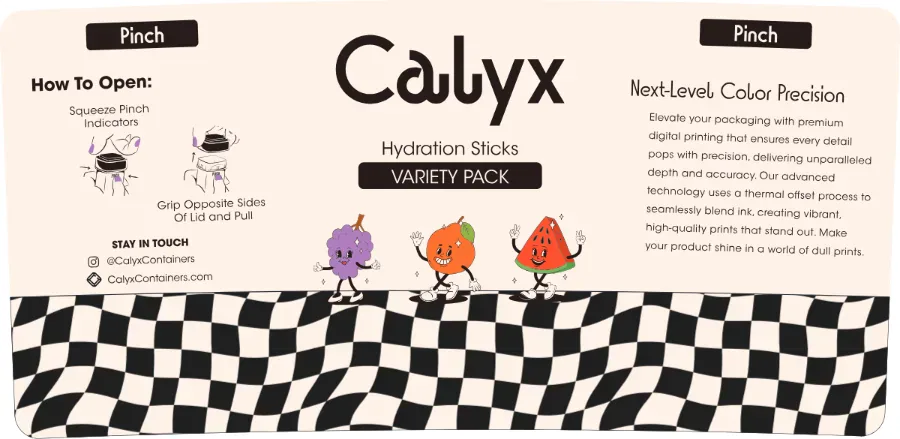
Size the label from the container
Enter the diameter and panel height to get the wrap length, the label height and a dieline preview.
Open the size calculator →The films: PET-G, OPS and PLA
The film is the single biggest decision. It sets how tightly the sleeve can conform, how it feels in the hand, the temperature it shrinks at, and (increasingly the deciding factor) what happens to it at end of life. Three films cover most of the market.
| Film | Shrink behavior | Recyclability note |
|---|---|---|
| PET-G | Highest shrink; conforms to aggressive compound curves and steep tapers. | Dense film that sinks like PET flake, so a PET-G sleeve on a PET bottle can contaminate the stream unless it's removable or uses wash-off inks. |
| OPS (oriented polystyrene) | Moderate shrink at a lower temperature and gentler force, which is kinder to thin-walled or heat-sensitive containers. | Density of about 1.05 g/cm³, so it sinks with PET flake in float-sink sorting (as PET-G and PVC sleeves do) and is hard to separate; less aggressive shrink than PET-G. |
| PLA | Moderate shrink; a bio-based alternative positioned for sustainability. | Compostable in industrial facilities; not a drop-in for standard plastic recycling and should be kept out of PET streams. |
PET-G is the workhorse for full-body sleeves on complex shapes because it can shrink the most. OPS trades some of that shrink for a lower activation temperature and a softer feel, which suits delicate containers. PLA appeals to brands chasing a lower-impact story but carries real end-of-life caveats. There is also a newer class of crystallizable PET and floatable polyolefin films engineered specifically to survive recycling, and they are worth asking about if recyclability is a priority. Film also interacts with your other label decisions; if you're weighing facestocks elsewhere on the pack, our label materials guide covers the pressure-sensitive side.
How a shrink sleeve is applied
Application is a short, well-defined sequence, and the heat step is where most of the defects happen:
- SupplyThe sleeve arrives as a layflat roll: a printed, seamed tube collapsed flat and wound onto a core.
- Cut and placeAn applicator cuts the tube to the right length, opens it into a cylinder, and drops it over the container in the correct vertical position.
- ShrinkThe container travels through a heat tunnel. A steam tunnel transfers heat evenly and conforms tightly to complex shapes; a hot-air or infrared tunnel is simpler and lower-cost but less even on tricky contours.
- SetThe film contracts mostly around the circumference, with a little lengthwise pull, until it hugs every curve. Any tamper-band perforations settle over the cap.
Get the heat profile wrong and the failure modes are visible: wrinkles, a wavy top edge, distortion across panels, or a sleeve that bridges a recess instead of tucking into it. The more aggressive the container's shape, the more the process depends on both the right film and an accurate shrink profile. That is the subject of the sizing section below.
Have your artwork? See the price for every quantity in seconds.
Get instant label pricing →Shrink sleeve vs pressure-sensitive label
The most common question isn't which film. It's whether to use a sleeve at all instead of a pressure-sensitive (PS) label, the peel-and-stick label that covers most of the market. Neither is universally better; they solve different problems.
| Factor | Shrink sleeve | Pressure-sensitive label |
|---|---|---|
| Coverage | Full 360°, edge to edge | Front/back panels or a partial wrap |
| Container shape | Follows tapers and compound curves | Best on straight cylinders and flats |
| Tamper / neck band | Built in from the same sleeve | Needs a separate band or seal |
| Equipment | Applicator plus a heat tunnel | Simpler applicator, or hand-apply at low volume |
| Low-volume simplicity | More setup to dial in | Lower barrier, faster to start |
| Recyclability | Can complicate container sorting | Depends on facestock and adhesive |
REACH FOR A SLEEVE WHEN
- You need full-body coverage
- You want the graphics to flow over a shaped or tapered container
- You need a tamper band as part of the decoration
REACH FOR A PS LABEL WHEN
- A clean front-and-back label does the job
- You want lower tooling and application cost
- The container is a simple cylinder where a wrap looks just as good
Sizing a PS label is a different exercise; see the label sizes guide for that path. Many brands run both across a range: a sleeve on the hero SKU with a sculpted bottle, a PS label on the straight-walled line extensions.
Going with a pressure-sensitive label on a straight-walled container? Start the quote from your artwork.
Upload artwork for an instant quote →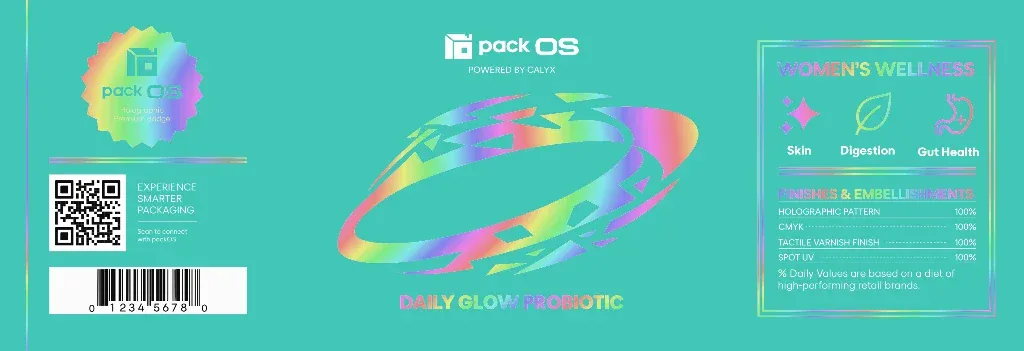
Material picker
Compare the stocks we price instantly
White, clear, silver and holographic BOPP, squeeze BOPP and Beverage White with CHILL adhesive. Pick one and see what it suits.
Open the material picker →The recyclability catch
A full-body sleeve is a decoration advantage and a recycling liability at the same time. Because it covers most of the container, the optical and near-infrared sorters at a recycling facility can read the sleeve instead of the bottle, and route the container to the wrong stream. If the sleeve's plastic differs in density from the container's, it can also contaminate the reprocessed flake.
There are real fixes, and they're worth designing in from the start:
- Perforated tear-away sleeves the consumer removes before recycling.
- Wash-off inks that release in the caustic wash so the flake comes out clean.
- Float-separable films: low-density polyolefin sleeves (density below 1.0 g/cm³) that float and separate from sinking PET flake. Standard OPS, PET-G and PVC sleeves sink with it.
- Compatible materials: matching the sleeve to the container so the whole unit recycles together.
Don't assume a sleeve is recycling-friendly, and don't assume it isn't. It depends entirely on the film and the design.
The Association of Plastic Recyclers maintains design guidance for exactly this, and it changes as sorting technology improves, so check the current version rather than a rule of thumb. The broader material picture (glass versus plastic, weight versus recyclability) is covered in our glass vs plastic comparison.
Want to talk it through with someone? Book an enterprise demo.
Book an enterprise demo →Sizing a sleeve to the container
A sleeve is specified by two numbers plus a profile:
- Layflat widthLarge enough for the sleeve to clear the widest point it must pass over when it drops on, then shrink down to the narrowest point it must hug.
- Cut heightSets how much of the container the sleeve covers.
- Shrink profileThe difference between the largest and smallest diameters the sleeve spans. It determines how much shrink you need, and therefore which film can do the job.
A near-straight cylinder needs very little shrink; a bottle that flares at the shoulder and pinches at the waist needs a high-shrink film like PET-G.
Because the film contracts unevenly, the artwork can't be drawn flat and printed as-is. It's deliberately pre-distorted, stretched in the areas that will shrink the most, so it reads correctly once the sleeve is on the container. That distortion is calculated from the container's measured profile, which is why the container geometry matters as much as the graphics, and why color and image elements have to stay in registration through the shrink.
All of this means the container drives the sleeve, not the other way around. The neck finish, the shoulder, the widest and narrowest diameters: those dimensions decide the layflat, the film, and the pre-distortion map.
If you're still choosing the container itself, our bottle types guide walks through the shapes and neck finishes that a sleeve then has to conform to.
Instant label pricing
Upload your artwork and see the price
Drop in a PDF or AI file. PackOS reads the size, shape and colors and prices it from 10,000 labels per size.
Upload artwork →Where PackOS fits
A shrink sleeve is a decoration wrapped onto a three-dimensional container, so the artwork has to be pre-distorted for the shrink and proofed on the real container shape. Sleeves are made and applied by sleeve converters and their finishing lines; PackOS does not quote or apply shrink sleeves. PackOS Quick Quote prices pressure-sensitive roll labels, and a pressure-sensitive label can often replace a sleeve on straight-sided containers. To price one, upload the label artwork for an instant quote.
Frequently asked questions
What is a shrink sleeve label?
A shrink sleeve is a printed plastic tube that slips over a container and, when passed through a heat tunnel, shrinks tight to the container's shape. Because it wraps the whole body, it gives full 360-degree, edge-to-edge graphics and can also form a tamper-evident band over the cap or a neck band on a bottle.
What material are shrink sleeves made from?
The common shrink films are PET-G, OPS (oriented polystyrene), and PLA. PET-G delivers the highest shrink and conforms to aggressive compound curves, OPS shrinks at lower temperatures with a gentler force, and PLA is a bio-based alternative. The right film depends on the container shape, how much the sleeve has to shrink, and your recyclability goals.
Are shrink sleeve labels recyclable?
It depends on the film and the container. A full-body sleeve can interfere with how a container is sorted and can contaminate the recycling stream when its plastic differs from the container's. Options that help include perforated sleeves the consumer removes, wash-off inks, and float-separable films. Check current APR design guidance rather than assuming a sleeve is recycling-friendly.
When should I use a shrink sleeve instead of a pressure-sensitive label?
Choose a shrink sleeve when you need full-body coverage, want graphics to follow a complex or tapered shape, or need a built-in tamper band. Choose a pressure-sensitive label when a simpler front-and-back label is enough, you want lower tooling and application cost, or the container is a straightforward cylinder.
Why does shrink sleeve artwork look distorted before printing?
The film shrinks unevenly, so the artwork is pre-distorted on purpose. It is stretched in the areas that will shrink most, so it reads correctly once the sleeve is on the container. This distortion is calculated from the container's profile, which is why an accurate shrink profile matters as much as the graphics.