
Pressure-Sensitive Label Construction & Checklist
A label can look right on a proof and still need a different construction for your container or application line. Use this guide to turn a material description into a traceable specification, compare supplier proposals and document approval before ordering across SKUs.
THE SHORT ANSWER
Pick the material by where the label will live, then price it. A conventional liner-backed pressure-sensitive label combines a printable face stock, an adhesive and a release liner. The face and adhesive remain on the container; the liner is removed during application. Approve the specific construction against your container, line and use conditions, not only a name such as “white film” or “permanent adhesive.” Linerless labels use a different construction and are outside this guide.
Pick a material by where the label will live
Start with the conditions, not the material name. Our core is general-purpose acrylic adhesive labels on BOPP film: white, clear, silver or holographic, finished with a gloss, matte or soft-touch laminate. For utility labels, ask us about thermal transfer and direct thermal paper stocks.
Material picker
Where will your label live?
White BOPP, general-purpose acrylic adhesive
Conditions it suits
- Dry glass, rigid plastic or carton
- Room temperature, indoors
- Opaque white film under the print
- Gloss, matte or soft-touch laminate over the print
Clear BOPP, general-purpose acrylic adhesive
Conditions it suits
- A no-label look on glass or clear plastic
- The container or product shows behind the design
- White ink under any print that needs to read
- Gloss, matte or soft-touch laminate over the print
Silver BOPP, general-purpose acrylic adhesive
Conditions it suits
- A metallic silver film behind the ink
- Dry glass, rigid plastic or carton
- Film left unprinted where the silver should show
- Gloss, matte or soft-touch laminate over the print
Holographic BOPP, general-purpose acrylic adhesive
Conditions it suits
- A rainbow holographic film behind the ink
- Dry glass, rigid plastic or carton
- Film left unprinted where the hologram should show
- Gloss, matte or soft-touch laminate over the print
Squeeze BOPP
Conditions it suits
- Flexible PE bottle or tube
- Squeezed and flexed every use
- Wet hands in the kitchen or bathroom
- Room temperature
Beverage White with CHILL adhesive
Conditions it suits
- Applied cold or damp on the filling line
- Chilled storage, coolers and ice buckets
- Condensation as the product warms
- Glass or aluminum
Thermal transfer and direct thermal paper
Conditions it suits
- Utility labels printed on demand
- Barcodes, shipping, warehouse and date or lot codes
- Direct thermal for short-term use, thermal transfer for longer life
- Direct thermal kept away from heat and light
Specialty adhesives and paper stocks
Conditions it suits
- Freezer, outdoor, removable or wash-off requirements
- Wine, spirits and craft products on coated or textured paper
- A paper feel and texture in the hand
- Tell us the container and the conditions
Not sure which one? Tell our team the container and the conditions and we will point you to the right construction. Confirm it with a finished-label trial.
Why start in PackOS
Once you know the details, see the price, the dieline and your label on a roll in one place.
From file to price in PackOS
What you get in PackOS
Skip the spec form
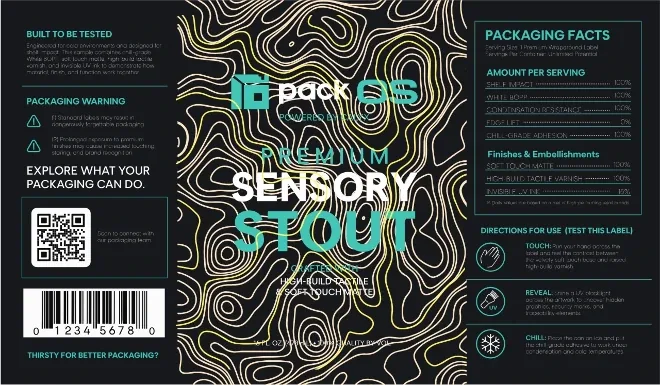
Upload a PDF or AI file and PackOS reads the size, shape, colors and finishes from your design. Nothing to retype.
Upload artwork →Instant price · sample label
| Run | Per label | Total |
|---|---|---|
| 10,000 | $0.1996 | $2,346 |
| 60,000 | $0.1692 | $10,500 |
| 110,000 | $0.1670 | $18,722 |
| 150,000 | $0.1663 | $25,290 |
| 200,000 | $0.1658 | $33,500 |
| 250,000 | $0.1655 | $41,725 |
Know the price before you ask
Every quantity is priced as soon as the file is read, with no waiting on a quote. Runs start at 10,000 labels per size with at least 2,500 per SKU. Your price depends on your artwork. Order online; the proof and a payment link follow by email.
Get instant label pricing →
Get a production dieline
No artwork yet? Draw the die with cut, bleed and safe-area lines so your designer starts from the right shape. We email it with your quote.
Create a label dieline →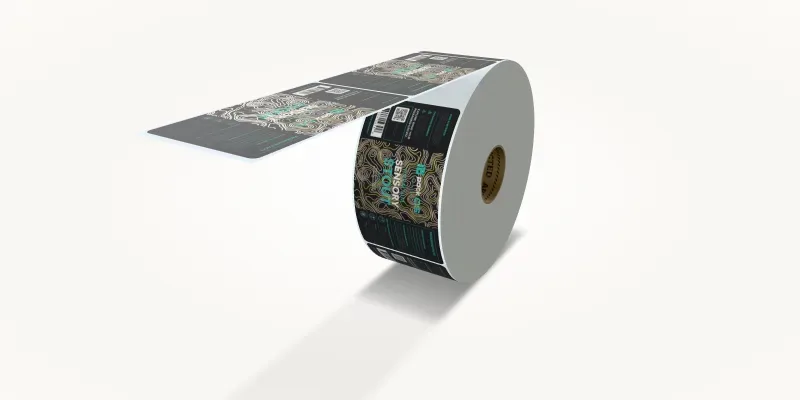
See it on the roll first
Turn your label on a 3D roll in the copy position you choose and check it before you order.
Upload artwork →Labels only. Foil, embossing and other specialty work are quoted by our team.
What is a pressure-sensitive label?
A pressure-sensitive label uses an adhesive that bonds when pressed onto a compatible surface, without a separate water or heat activation step. It is also called a self-adhesive label. For conventional roll labels, the release liner supports the label until application.
Initial attachment is only one checkpoint. A buyer also needs to know how the finished label prints, dispenses, stays attached and looks after the intended handling and exposure. A material data sheet is a starting point for that review; a printed proof alone cannot establish those results.
Face stock, adhesive and liner: specify the actual grades
Face stock: the printable surface
Paper, BOPP, PE and PET describe material families, not interchangeable grades. Identify the supplier’s grade, thickness, opacity or clarity, surface treatment and printing compatibility. A clear label also needs an approved white-ink plan where the artwork requires opacity. Compare candidate materials in the label materials guide, then confirm the finished construction on the intended container.
Adhesive: compatibility with the surface and conditions
“Permanent,” “removable” and “wash-off” describe intended behavior. They do not guarantee performance on every container. Record the adhesive code and the supplier’s conditions for use. Evaluate removal or wash-off under the actual agreed conditions if that is part of the requirement. See the label adhesive guide for the selection questions.
Release liner: part of the application specification
Paper and film liners have different grades, thicknesses and release characteristics. Neither name guarantees uninterrupted dispensing. Ask the converter and applicator owner to agree the liner, die-cut quality, release and roll build for the line. Connect that specification to unwind direction and core and roll diameter limits. Arrange a liner collection route only where the receiving program accepts that material.
Have your artwork? See the price for every quantity in seconds.
Get instant label pricing →A construction specification buyers can compare
Ask each pressure-sensitive label manufacturer or converter to return the same fields. Keep the material supplier’s construction reference distinct from the converter’s finished-label specification. Record “unconfirmed” where a response is missing instead of treating silence as equivalence.
| Record | Ask the supplier to identify | Keep with the order |
|---|---|---|
| Construction identity | Supplier, construction code and technical data sheet revision | Source document and proposed alternate codes |
| Face stock | Exact grade, thickness with units, surface treatment and appearance | Printed sample and approved appearance reference |
| Adhesive | Exact grade; application and service conditions | Container compatibility and trial evidence |
| Liner | Grade, thickness, release specification and line constraints | Applicator requirements and dispensing trial |
| Converted label | Ink, coating or laminate; dieline; roll build; revision | Approved artwork and finished-label specification |
| Release decision | What was tested, exceptions, approval owner and date | Evidence references and change-control record |
Keep quantity by SKU, delivery terms and pricing in a linked label quote-comparison worksheet. A lower price is only comparable when the construction, finish and delivery assumptions are understood.
Separate application conditions from service conditions
APPLICATION TEMPERATURE
- Concerns the conditions when the label is applied
- Record the container surface temperature as well as the room conditions
SERVICE TEMPERATURE
- Concerns the conditions after application and any required bond development
- Record how long after labeling the product will be filled, chilled, shipped or handled
Do not use a storage-temperature claim as permission to apply to a cold or wet surface. Ask the supplier for the relevant limits, conditioning and dwell requirements for the exact construction. Agree the trial sequence before testing so that a dry, room-temperature sample does not stand in for a materially different production process.
Want to talk it through with someone? Book an enterprise demo.
Book an enterprise demo →Check printing, cutting and dispensing together
- Printing: confirm the face stock and coating are compatible with the selected print process and required appearance. Evaluate the printed and finished sample, including variable data where used.
- Cutting: confirm the finished shape and die-cut quality. Die cutting describes the cutting process or shape; kiss cutting describes cutting through the label layers while leaving the liner intact. These are not mutually exclusive alternatives.
- Dispensing: trial representative rolls on the intended applicator. Record line settings, operating conditions, observed skips, edge lift, liner damage or placement variation, and the agreed acceptance criteria.
- Artwork: use the approved label dieline, bleed and safe-area specification. A construction change may require a new print or application review even when the outline is unchanged.
Finish picker
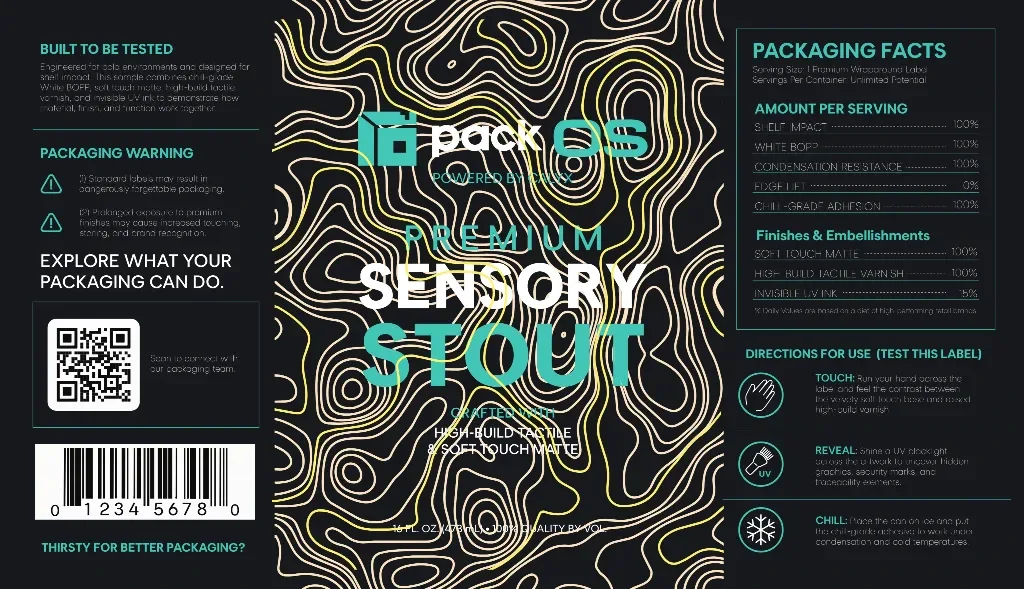
Compare gloss, matte and soft touch
See the same label under each laminate, then upload your artwork for an instant price.
Compare the finishes →Labeling supplements? Start with the supplement label page.
Supplement labels →Turn exposure conditions into trial questions
Choose candidates with the supplier, then test the actual construction. These scenarios organize the discussion; they are not automatic material prescriptions.
| Use condition | Question to resolve | Evidence to record |
|---|---|---|
| Chilled beverage or condensation | Is the container dry at labeling, and when does cooling begin? | Application sequence, exposure conditions and observed attachment/appearance |
| Squeezable bottle | How does the complete label behave as the filled container flexes? | Representative container, agreed flex sequence and observed wrinkles or lift |
| Oil, cleaner or repeated handling | Which contact and rubbing conditions must the finished label withstand? | Defined exposure method, duration and results |
| PP or PE container | Has the adhesive been evaluated on this exact surface and finish? | Container part/lot, surface preparation and trial reference |
| Removal or reuse requirement | What removal conditions and residue criteria apply? | Agreed method and result on the actual container |
Do not infer recyclability from a material family or a wash-off description alone. Ask for evidence applicable to the complete package and the intended collection or processing stream.
Have artwork and a proposed construction? Review the detected attributes against your specification.
Upload artwork for an instant quote →Include finishes in the approved construction
A varnish or laminate changes the finished surface and may be selected for appearance or protection. Specify the actual coating or film and the performance required; do not assume that every finish supplies water, abrasion or UV resistance. Evaluate it as part of the finished label.
Explore visual options in the enterprise label finishes showcase and use the finishes and laminates guide to prepare the supplier discussion. Confirm availability, proof requirements and pricing for the chosen construction.
Download the label construction and trial worksheet
Download the construction trial worksheet (CSV)
The blank worksheet opens in a spreadsheet. Duplicate it for each SKU and proposed construction; use the record ID to connect it to your artwork, quote and supplier documents. Each row names a field, explains what to enter and leaves space for a value and evidence reference. It contains no preset acceptance limits or automatic approval.
- DefineRecord the container, proposed construction and the actual application/use conditions.
- AgreeName the trial owner, method, sample count and acceptance criteria before the trial.
- ObserveRecord the actual conditions, results, deviations and evidence. Repeat the trial rows for each method or condition.
- DecideDistinguish proposed, sample-qualified and release-approved status. Record who authorized the specific SKU/construction and any open restrictions.
Keep sensitive supplier pricing, customer information and approval records in your own controlled system. Downloading the file does not submit its contents to packOS.
No artwork yet? Draw a production dieline with cut, bleed and safe-area lines.
Create a label dieline →Control substitutions and repeat orders
For a repeat order, match the released construction, artwork and roll specification to the supplier’s order confirmation.
Ask the supplier to flag a different face stock, adhesive, liner, finish or production specification before manufacture. “Equivalent white film” is not a complete substitution record.
Link a proposed alternate to the original specification, explain what changed and have the responsible owner decide which evidence or trials need renewal. A previous trial belongs to the tested configuration and conditions; it is not blanket approval for every SKU, container or site. Keep open exceptions visible until the release owner resolves them.
Instant label pricing
Upload your artwork and see the price
Drop in a PDF or AI file. PackOS reads the size, shape and colors and prices it from 10,000 labels per size.
Upload artwork →Bring the construction into your label quote
Prepare the container reference, label dimensions, artwork revision, quantities by SKU and proposed construction. Start a label quote, review the detected attributes and compare the selected specification with your requirements. Read the available pricing, tooling and delivery assumptions before confirming. Quick Quote prices our standard label stocks, each with its adhesive and liner already set; other constructions are quoted by our team.
Use the custom printed roll-label buyer guide to connect construction approval with the SKU schedule and release plan. If a required material or finish is not confirmed in the quote, ask the packOS team to review it before treating it as included.
Frequently asked questions
What are the layers of a pressure-sensitive label?
A conventional liner-backed label has a face stock, pressure-sensitive adhesive and release liner. Inks, coatings or laminates may add layers. The face and adhesive stay on the container; the liner is removed during application. Linerless labels use a different construction.
What should I ask a pressure-sensitive label manufacturer for?
Ask for the supplier construction code, exact face stock, adhesive and liner grades, technical data sheet revision, finished-label specification and relevant trial evidence. Connect the response to your container, artwork, roll build and quantities by SKU.
Is application temperature the same as service temperature?
No. Application temperature describes conditions when the label is applied. Service temperature concerns later use, after any required bond development. Confirm the supplier’s limits and dwell requirements, including the actual container surface conditions.
Is BOPP always better than paper for labels?
No material family is best for every use. Compare the specific grades, print process, appearance, container and exposure conditions. Qualify the complete printed construction rather than choosing from the family name alone.
Can I ignore the release liner when ordering roll labels?
No. Record the liner grade and thickness, release specification, die-cut quality and roll build. Confirm dispensing on the intended applicator; a film liner is not a guarantee against breaks or misfeeds.
Does removable adhesive guarantee clean removal?
No. Verify the specific adhesive on the actual container under the agreed duration and removal conditions. Record acceptable residue and surface appearance before evaluating the result.
Does wash-off adhesive make my package recyclable?
A wash-off description alone does not establish recyclability. Ask for evidence applicable to the complete package, the intended recycling or reuse process and its conditions.
Does the construction worksheet approve a label for production?
No. It organizes specifications, trial conditions, results and evidence. Your responsible owner must set acceptance criteria, review exceptions and authorize the specific construction for release.
When should a label construction be reviewed again?
Review proposed changes to the face stock, adhesive, liner, finish, container, artwork or application process. Have the responsible owner identify which approvals and trials are affected before releasing the changed configuration.