
Label Adhesives: Permanent, Removable & Cold Use
A label that stays on a room-temperature jar can behave differently on a cold bottle, a squeezed container or a returnable package. Give the supplier the actual sequence of use, then approve an identified construction against agreed criteria.
THE SHORT ANSWER
Pick the material by where the label will live, then price it. Choose label adhesive by the complete job: container surface and geometry, face stock and label dimensions, application conditions, later exposure and intended removal. Permanent, removable, repositionable and freezer describe different requirements; none is a substitute for an exact construction code and evidence from your application.
Pick a material by where the label will live
Start with the conditions, not the material name. Our core is general-purpose acrylic adhesive labels on BOPP film: white, clear, silver or holographic, finished with a gloss, matte or soft-touch laminate. For utility labels, ask us about thermal transfer and direct thermal paper stocks.
Material picker
Where will your label live?
White BOPP, general-purpose acrylic adhesive
Conditions it suits
- Dry glass, rigid plastic or carton
- Room temperature, indoors
- Opaque white film under the print
- Gloss, matte or soft-touch laminate over the print
Clear BOPP, general-purpose acrylic adhesive
Conditions it suits
- A no-label look on glass or clear plastic
- The container or product shows behind the design
- White ink under any print that needs to read
- Gloss, matte or soft-touch laminate over the print
Silver BOPP, general-purpose acrylic adhesive
Conditions it suits
- A metallic silver film behind the ink
- Dry glass, rigid plastic or carton
- Film left unprinted where the silver should show
- Gloss, matte or soft-touch laminate over the print
Holographic BOPP, general-purpose acrylic adhesive
Conditions it suits
- A rainbow holographic film behind the ink
- Dry glass, rigid plastic or carton
- Film left unprinted where the hologram should show
- Gloss, matte or soft-touch laminate over the print
Squeeze BOPP
Conditions it suits
- Flexible PE bottle or tube
- Squeezed and flexed every use
- Wet hands in the kitchen or bathroom
- Room temperature
Beverage White with CHILL adhesive
Conditions it suits
- Applied cold or damp on the filling line
- Chilled storage, coolers and ice buckets
- Condensation as the product warms
- Glass or aluminum
Thermal transfer and direct thermal paper
Conditions it suits
- Utility labels printed on demand
- Barcodes, shipping, warehouse and date or lot codes
- Direct thermal for short-term use, thermal transfer for longer life
- Direct thermal kept away from heat and light
Specialty adhesives and paper stocks
Conditions it suits
- Freezer, outdoor, removable or wash-off requirements
- Wine, spirits and craft products on coated or textured paper
- A paper feel and texture in the hand
- Tell us the container and the conditions
Not sure which one? Tell our team the container and the conditions and we will point you to the right construction. Confirm it with a finished-label trial.
Why start in PackOS
Once you know the details, see the price, the dieline and your label on a roll in one place.
From file to price in PackOS
What you get in PackOS
Skip the spec form
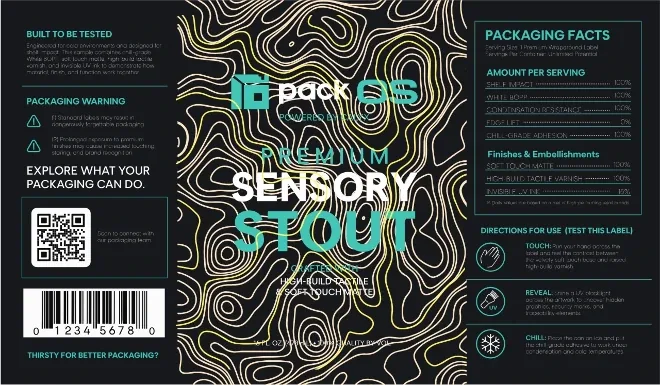
Upload a PDF or AI file and PackOS reads the size, shape, colors and finishes from your design. Nothing to retype.
Upload artwork →Instant price · sample label
| Run | Per label | Total |
|---|---|---|
| 10,000 | $0.1996 | $2,346 |
| 60,000 | $0.1692 | $10,500 |
| 110,000 | $0.1670 | $18,722 |
| 150,000 | $0.1663 | $25,290 |
| 200,000 | $0.1658 | $33,500 |
| 250,000 | $0.1655 | $41,725 |
Know the price before you ask
Every quantity is priced as soon as the file is read, with no waiting on a quote. Runs start at 10,000 labels per size with at least 2,500 per SKU. Your price depends on your artwork. Order online; the proof and a payment link follow by email.
Get instant label pricing →
Get a production dieline
No artwork yet? Draw the die with cut, bleed and safe-area lines so your designer starts from the right shape. We email it with your quote.
Create a label dieline →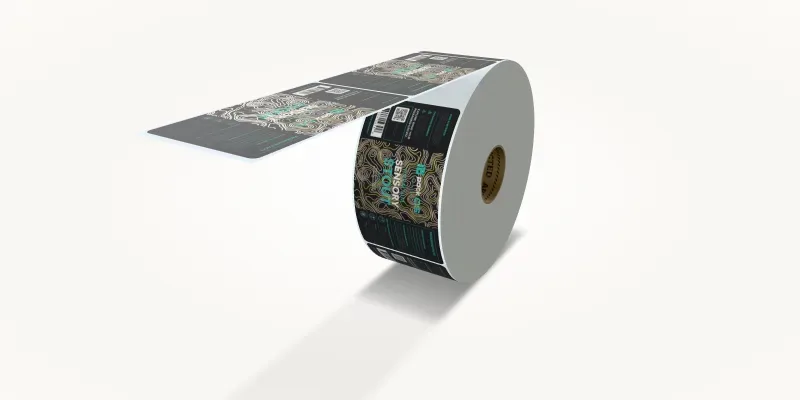
See it on the roll first
Turn your label on a 3D roll in the copy position you choose and check it before you order.
Upload artwork →Labels only. Foil, embossing and other specialty work are quoted by our team.
What a label adhesive actually does
A pressure-sensitive adhesive attaches the label through contact and applied pressure. In the ordered product it works with a particular face stock, liner, printed image and finish. Keep those components together in the label construction specification.
Three terms help you ask better questions: tack concerns initial adhesion under the stated test conditions; peel adhesion concerns removal force under a defined method; cohesion concerns internal adhesive strength. A value without its test surface, method and conditioning is difficult to compare. Ask which evidence represents your use.
A material name is not an approval. Request the supplier’s construction reference and relevant technical data, then connect them to your container and process. See the label materials guide for face-stock and liner questions.
Compare adhesive requirements, not strength labels
Use categories to describe the job. UPM’s adhesive portfolio distinguishes permanent, removable, wash-off and open-closure uses. These categories may overlap with other requirements such as cold application; they are not a single scale from weak to strong. UPM adhesive overview
| Requirement | What to tell the supplier | Evidence to request |
|---|---|---|
| Permanent attachment | Expected life, surface and service sequence | Attachment and appearance on the specified construction and container |
| Clean removal | When, how and from which surface the label is removed | Agreed residue, tearing and surface-change outcomes after the intended use |
| Repositioning | Placement adjustment or repeated reapplication; describe which | Supported adjustment conditions and subsequent attachment/removal behavior |
| Cold application or storage | Conditions at attachment and all later temperature changes | Application and service limits, plus a representative sequence trial |
| Difficult or textured surface | Actual container reference, coating, geometry and condition | Supplier-supported candidate and finished-label evidence on that surface |
| Wash-off or process removal | Named container system and actual wash process | Evidence for that process and the complete decorated package |
Adhesive chemistry alone does not settle these questions. If a supplier proposes an acrylic, rubber-based or other formulation, ask why that exact construction fits the requirement. Avoid turning a chemistry preference into a substitute for performance evidence.
Have your artwork? See the price for every quantity in seconds.
Get instant label pricing →Describe the actual container surface and geometry
Start with the container supplier item and a representative sample. Identify its material, coating or treatment, texture, shape and intended label position. A broad description such as “plastic bottle” leaves important differences unresolved.
Surface energy can affect how an adhesive contacts a surface, but the resin family alone is not a complete diagnosis. Ask the supplier whether a proposed construction is intended for the actual surface. Record contamination, condensation and production variation rather than assuming the sample represents every container.
Label dimensions and shape matter to the application brief. Include corners, edges, curvature, overlaps and squeeze behavior. A construction proven on one panel should not automatically inherit approval on a smaller radius or a different label geometry. Use the label measuring guide and provide the placement drawing.
Separate application, conditioning and service
Avery Dennison’s cold-temperature overview distinguishes temperature during labeling from temperature after application and recommends testing the complete construction. Its February 2022 ANZ portfolio is a technical example, not a statement of current US product availability or packOS temperature limits. Cold Temperature overview, page 2
- ApplicationRecord the surface temperature and whether the surface is dry, wet, condensed or frosted when the label meets it. Include the line or hand-application method and relevant supplier settings.
- ConditioningAgree the time and environment between attachment and the next operation.
- ServiceDescribe storage, transport, display, handling, product contact and eventual removal.
“Freezer” and “all-temperature” do not establish permission to label any wet or frozen surface. Request confirmation for the exact proposed condition. Likewise, a warm-applied label entering refrigerated storage is a different application from a label applied after the container has chilled.
Define water, oil, cleaning or outdoor exposure in concrete terms. The complete printed construction needs to meet the requirement; neither a film face nor a particular adhesive name proves that it will. For cold beverages, use the bottle-to-cooler planning guide.
Labeling food or beverage products? Start with the food and beverage label page.
Food and beverage labels →Two cold-chain briefs that need separate review
| Planning example | Critical difference | Ask before release |
|---|---|---|
| Label a dry container, then chill the product | Attachment happens before cold storage | What application and conditioning conditions are supported before chilling? |
| Label a container after cold storage | The surface may be cold or carry condensation at attachment | Does the proposed construction support the observed temperature and moisture state? |
Both briefs might be described as “refrigerated labels,” yet they ask different things of the construction and line. Write the sequence in the quote request and sample record. If production later changes the sequence, review that change rather than relying on the previous job name.
Labeling food or drinks that go into cold storage? See the label options for that category.
See food & beverage labels →
Food and beverage labels
Labels for bottles, cans and jars
See the stocks and adhesives we print for food and beverage brands, including Beverage White with CHILL.
See food and beverage labels →Define removal and repositioning precisely
A permanent label is intended to stay attached through the specified use. A removable requirement adds a later removal outcome. Repositioning adds an adjustment or reapplication requirement. Describe those outcomes separately, including when and how they should happen.
UPM describes different removable technologies for clean peel, repositioning and peel-and-reseal applications. This is a reason to ask about the exact system, not to assume that every removable label supports every behavior. UPM removable adhesive applications
CLEAN REMOVAL: AGREE
- Acceptable residue
- Surface marking and label tearing
- Evaluation after representative time and exposure
REPOSITIONING: AGREE
- The adjustment window
- The number of placements
- The subsequent bond requirement; do not assume every repositionable adhesive later becomes permanent
Wash-off is a separate process requirement. Specify the container system and wash conditions, and request evidence for the complete package. Hand peel, industrial removal and recycling compatibility are different outcomes and should have separate evidence.
Investigate symptoms before changing the adhesive
| Observed symptom | Collect first | Question for the supplier |
|---|---|---|
| Edge lifting on a curved container | Placement, geometry, construction, application settings and time to lift | Does the candidate match this curvature and label design? |
| Bubbles or tunnels | Photographs, when they appeared and actual line conditions | Which application, construction or container factors need a controlled comparison? |
| Poor initial attachment | Surface condition and temperature, stock identification and line record | Were the proposed application conditions actually met? |
| Residue or surface change after removal | Surface reference, time in service, exposure and removal method | Was this removal outcome part of the approved brief? |
Keep an untreated reference sample and change one variable at a time where practical. Record what changed and who approved the comparison. Do not add an unapproved cleaner, primer or surface treatment merely to make a sample pass; involve the container and label suppliers before changing the production process.
The label adhesion troubleshooting guide and bubbling and peeling guide cover related symptoms. Use the exact construction and process record to support any corrective action.
No artwork yet? Draw a production dieline with cut, bleed and safe-area lines.
Create a label dieline →Build a supplier request that can be answered
- Identify the surface: container supplier, item, lot or representative sample, material, coating and label position.
- Define the label: dimensions, shape, face-stock candidate, print, finish and artwork revision.
- Describe the sequence: application conditions, conditioning, storage, handling and relevant exposure.
- State the outcome: attachment, appearance, legibility and any removal or repositioning requirement.
- Ask for evidence: exact proposed construction, data-sheet revision, sample plan, agreed criteria and approval owner.
Download the construction trial worksheet (CSV)
Use the existing worksheet instructions to retain the trial and decision record. The blank worksheet does not qualify a construction or submit completed supplier records to packOS. Keep restrictions and unresolved questions visible before order release.
Instant label pricing
Upload your artwork and see the price
Drop in a PDF or AI file. PackOS reads the size, shape and colors and prices it from 10,000 labels per size.
Upload artwork →Bring adhesive requirements into your label quote
Upload the artwork, review the detected attributes and confirm the offered specification and quantities. Adhesive suitability cannot be established from artwork alone. In an instant quote, the adhesive is set by the facestock you select. For a removable, repositionable, freezer or wash-off requirement, send the application brief and our team will confirm whether a suitable construction is available.
For enterprise orders, connect construction approval to the SKU schedule and approved artwork revision. A substitution or changed application process needs review before release. Use the custom roll-label buying checklist for the complete request and the quote comparison guide to keep equivalent requirements aligned.
Frequently asked questions
What is the difference between permanent and removable label adhesive?
Permanent constructions are intended to remain attached during the specified use. Removable constructions are intended to permit removal under defined conditions. State the surface, time in service, removal method and acceptable residue or surface change. Confirm the proposed construction rather than treating either category as a universal performance promise.
What is the difference between application and service temperature?
Application temperature describes conditions when the label is attached. Service temperature describes conditions after it has been applied. A construction supported for cold storage may still need a warmer or drier application surface. Check both requirements for the exact construction and record the actual production sequence.
Can freezer labels be applied to frozen or damp containers?
Some constructions are designed for specific cold or difficult application conditions, but the word freezer does not establish suitability for frost, condensation or moisture. Describe the actual surface state and temperature, request supplier confirmation, and trial representative finished labels before release.
Why will a label not stick to plastic?
Possible causes include a construction mismatch, the container surface or coating, contamination, application conditions, geometry or dispensing problems. Identify the container and collect the process facts before changing adhesive. The symptom alone does not prove that a stronger adhesive is the right correction.
Is repositionable adhesive the same as removable adhesive?
Repositioning during placement and clean removal after use are different requirements. Ask the supplier what adjustment window or reapplication behavior is supported, what happens afterward, and whether later removal is also intended. Do not assume every repositionable construction becomes permanent or every removable label can be repeatedly reapplied.
Does high tack guarantee better label adhesion?
No. High initial tack describes only part of the requirement. The selected construction still needs to work with the container, label geometry, application process, service exposure and removal needs. Compare supplier evidence under relevant conditions rather than choosing from a stronger-or-weaker scale.
Are wash-off and removable labels interchangeable?
No. Hand removal and release in a defined industrial wash process are different uses. For wash-off requirements, identify the container system, wash conditions and required evidence. A label being removable does not prove compatibility with a returnable-container or recycling process.
What should I send with an adhesive specification request?
Send the container supplier reference and sample, label dimensions and placement, artwork and finish, application conditions, storage and use sequence, removal requirements and quantities by SKU. Ask for the exact proposed construction, relevant technical data and a trial plan with agreed acceptance criteria.