
Label Bubbles & Peeling: A First Inspection Guide
Before smoothing a bubble or replacing a label, document what changed and when. This first inspection guide helps you preserve useful evidence and choose the next investigation.
THE SHORT ANSWER
Pick the material by where the label will live, then price it. Bubbles, broad peeling and lifted edges are observations, not root causes. Record their location, timing, label and container lots, and the application and exposure sequence. Keep affected samples and suitable comparisons. Use that evidence to decide what to investigate; do not assume a fixed cleaning, warming or adhesive change will solve every case.
Pick a material by where the label will live
Start with the conditions, not the material name. Our core is general-purpose acrylic adhesive labels on BOPP film: white, clear, silver or holographic, finished with a gloss, matte or soft-touch laminate. For utility labels, ask us about thermal transfer and direct thermal paper stocks.
Material picker
Where will your label live?
White BOPP, general-purpose acrylic adhesive
Conditions it suits
- Dry glass, rigid plastic or carton
- Room temperature, indoors
- Opaque white film under the print
- Gloss, matte or soft-touch laminate over the print
Clear BOPP, general-purpose acrylic adhesive
Conditions it suits
- A no-label look on glass or clear plastic
- The container or product shows behind the design
- White ink under any print that needs to read
- Gloss, matte or soft-touch laminate over the print
Silver BOPP, general-purpose acrylic adhesive
Conditions it suits
- A metallic silver film behind the ink
- Dry glass, rigid plastic or carton
- Film left unprinted where the silver should show
- Gloss, matte or soft-touch laminate over the print
Holographic BOPP, general-purpose acrylic adhesive
Conditions it suits
- A rainbow holographic film behind the ink
- Dry glass, rigid plastic or carton
- Film left unprinted where the hologram should show
- Gloss, matte or soft-touch laminate over the print
Squeeze BOPP
Conditions it suits
- Flexible PE bottle or tube
- Squeezed and flexed every use
- Wet hands in the kitchen or bathroom
- Room temperature
Beverage White with CHILL adhesive
Conditions it suits
- Applied cold or damp on the filling line
- Chilled storage, coolers and ice buckets
- Condensation as the product warms
- Glass or aluminum
Thermal transfer and direct thermal paper
Conditions it suits
- Utility labels printed on demand
- Barcodes, shipping, warehouse and date or lot codes
- Direct thermal for short-term use, thermal transfer for longer life
- Direct thermal kept away from heat and light
Specialty adhesives and paper stocks
Conditions it suits
- Freezer, outdoor, removable or wash-off requirements
- Wine, spirits and craft products on coated or textured paper
- A paper feel and texture in the hand
- Tell us the container and the conditions
Not sure which one? Tell our team the container and the conditions and we will point you to the right construction. Confirm it with a finished-label trial.
Why start in PackOS
Once you know the details, see the price, the dieline and your label on a roll in one place.
From file to price in PackOS
What you get in PackOS
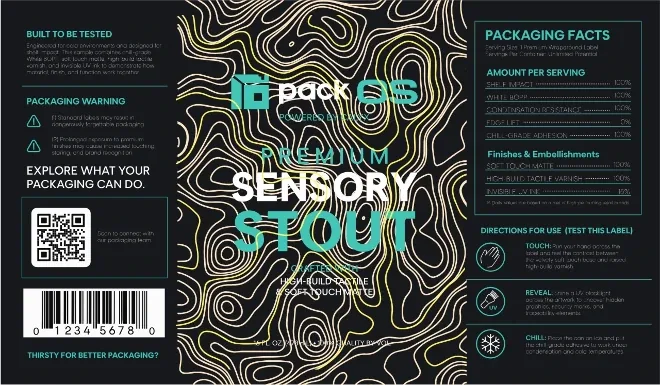
Skip the spec form
Upload a PDF or AI file and PackOS reads the size, shape, colors and finishes from your design. Nothing to retype.
Upload artwork →Instant price · sample label
| Run | Per label | Total |
|---|---|---|
| 10,000 | $0.1996 | $2,346 |
| 60,000 | $0.1692 | $10,500 |
| 110,000 | $0.1670 | $18,722 |
| 150,000 | $0.1663 | $25,290 |
| 200,000 | $0.1658 | $33,500 |
| 250,000 | $0.1655 | $41,725 |
Know the price before you ask
Every quantity is priced as soon as the file is read, with no waiting on a quote. Runs start at 10,000 labels per size with at least 2,500 per SKU. Your price depends on your artwork. Order online; the proof and a payment link follow by email.
Get instant label pricing →
Get a production dieline
No artwork yet? Draw the die with cut, bleed and safe-area lines so your designer starts from the right shape. We email it with your quote.
Create a label dieline →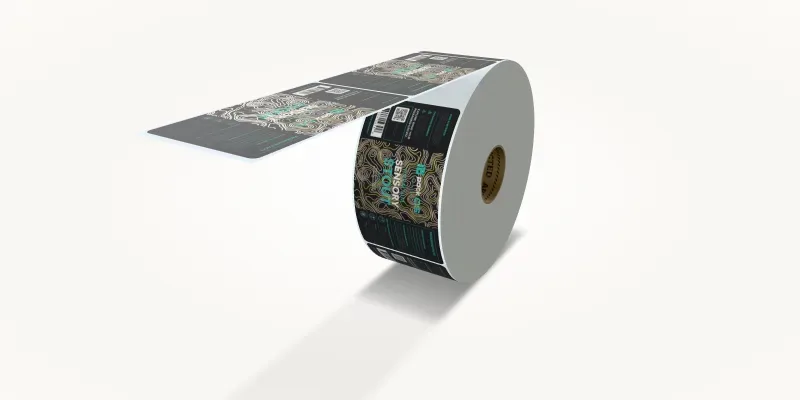
See it on the roll first
Turn your label on a 3D roll in the copy position you choose and check it before you order.
Upload artwork →Labels only. Foil, embossing and other specialty work are quoted by our team.
Separate raised areas, lifted edges and broad release
Describe a raised area within the face separately from an edge lifting away or a label releasing broadly. Record any wrinkles, print changes or visible separation between layers.
RECORD FIRST
- Photograph the whole container and a close view with a scale where practical.
- Record the inspected quantity and affected quantity, the SKU and the time.
- If you cannot tell which layer has changed, preserve the unit for supplier inspection.
DON'T
- Name the mechanism from appearance alone.
- Puncture or flatten the only failed sample before recording it.
Build a timeline instead of ranking guesses
| First observed | Useful comparison | What remains unresolved |
|---|---|---|
| Immediately after application | Comparable units from the same setup and lots | Placement, contact, equipment and construction may all need review. |
| After filling, chilling or storage | Records before and after that actual step | Timing narrows the investigation but does not identify one cause. |
| After shipping or handling | Retained references and affected shipment samples | Package contact, exposure and prior condition need to be compared. |
| Only in one SKU, roll or container lot | A documented comparison that changes that factor | Other differences may still explain the pattern. |
Record surface temperature and moisture state at application, the actual conditioning interval, and subsequent exposure. “Cold storage” alone does not explain what happened during labeling.
Have your artwork? See the price for every quantity in seconds.
Get instant label pricing →Choose a controlled next step
- Start from the recordStart with the approved specification and process record.
- Find the gapsIdentify missing information before changing several variables.
- Ask the converterAsk which comparisons can distinguish the proposed explanations.
- Agree the trialAgree sample counts, conditions, observation intervals and acceptance criteria.
Do not substitute a universal 24-hour wait, an unapproved solvent or warming procedure for supplier guidance. Check the exact construction’s application requirements and the product’s permitted handling. Retain original samples alongside the planned trials.
For the complete investigation record and a worked comparison, use why labels will not stick. The adhesive guide separates application, conditioning and service requirements. Avery’s troubleshooting guidance lists several possible adhesion contributors; a listed remedy must still fit the actual product and construction. Avery adhesion guidance
If the lifted area is an edge on a curve
Record the container’s actual label-zone geometry and the finished label dimensions. Identify whether the edge contacts bare container or an overlapping printed/finished label face. A narrow diameter can make construction selection demanding, but edge location does not prove that stiffness is the only issue.
Do not add overlap automatically: some designs intentionally use a gap or partial wrap. Use the curved-container and seam guide for an original tolerance example and the measurements to request. Qualification must still use the actual surfaces and application process.
Working out finished label dimensions for a curved label zone? Start from a dieline.
Create a label dieline →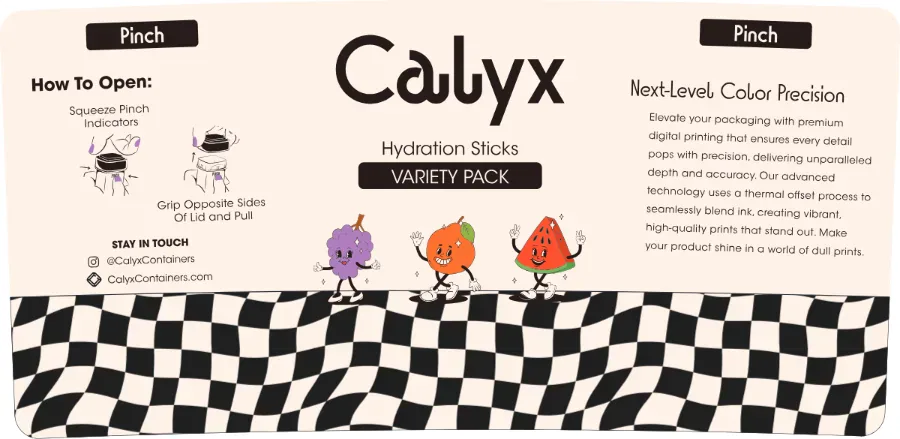
Label size calculator
Size the label from the container
Enter the diameter and panel height to get the wrap length, the label height and a dieline preview.
Open the size calculator →Keep observations separate from responsibility
A clean hand-applied comparison can be useful, but one successful label does not clear the material or prove the line is at fault. A failed comparison also does not establish a supplier defect. Differences in pressure, placement, sample condition or exposure may matter.
Share the evidence, agreed specification and process deviations with the responsible technical teams. Mark proposed explanations as hypotheses until supported. Keep the decision about cause separate from commercial responsibility.
Send a first inspection packet
- Container supplier item, material, lot and filled or empty state.
- Label roll/lot, construction reference, artwork revision and finish.
- Photos, affected and inspected counts, defect locations and observation times.
- Application setup and the sequence of storage, transport and product exposure.
- Retained failed units and comparison samples, clearly identified.
- What changed, what was held constant and what is still unknown.
Use your quality process to decide containment and release of affected stock. A visual troubleshooting guide cannot authorize shipment or establish a universal acceptable defect level.
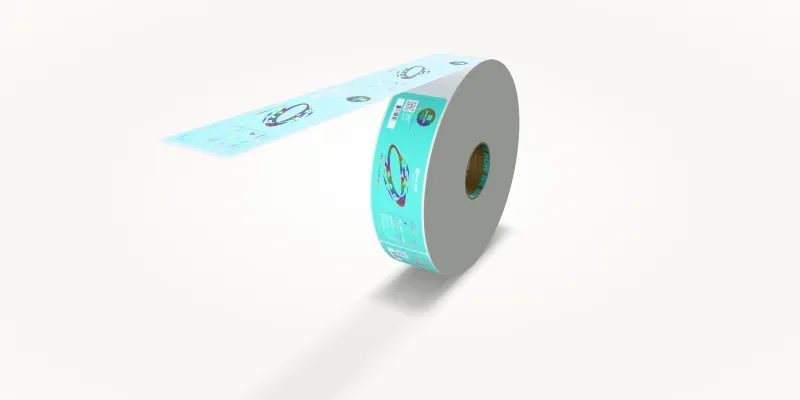
Instant label pricing
Upload your artwork and see the price
Drop in a PDF or AI file. PackOS reads the size, shape and colors and prices it from 10,000 labels per size.
Upload artwork →Turn the finding into a controlled reorder
Once a change is supported, record the revised construction or process, trial evidence and approval owner. Review related SKUs for the same conditions rather than assuming every product needs the same change. Retain the approved sample and revision with the order.
For a new custom roll-label request, upload artwork, review detected attributes and confirm the available specification. Keep the container, seam and service requirements with it; artwork alone cannot establish physical suitability.
Frequently asked questions
Why are bubbles appearing in my label?
A raised area within the label face can have several explanations. Record its location, timing and the construction and exposure history. Preserve the sample, including any visible layer separation, and use controlled comparisons before selecting a cause or remedy.
Why are the edges of my label peeling up?
Edge lift may involve construction, contact surfaces, geometry or application conditions. Identify the exact edge and whether it contacts the container or an overlapping finished label face. For curved containers, check the seam dimensions and representative trial results.
Should I smooth or puncture label bubbles before inspection?
Document and retain representative failed units before disturbing them. Smoothing or puncturing the only sample can remove useful evidence. Follow the responsible quality team’s procedure for investigation and disposition.
How long should I wait before judging adhesion?
Use the supplier’s conditioning guidance for the exact construction and agreed trial conditions. There is no universal 24-hour approval interval for every label. Record both the inspection time and any later exposure relevant to the product.
Does a clean-surface test establish who caused the problem?
No. It provides evidence from those conditions. Compare label and container lots, application, conditioning and exposure, and document uncontrolled differences. Cause and responsibility require a reviewed investigation.
What information helps a label supplier investigate bubbles or peeling?
Provide the label and container references, artwork and finish, photographs, affected and inspected counts, observation times, application setup, exposure timeline and retained samples. Distinguish observed facts from proposed explanations.