
Label Finishes: Matte, Gloss, Varnish & Foil
Choose the look on a physical sample, then check the proposed construction against its actual use. A finish name alone does not establish scratch resistance, water resistance or compatibility with your production line.
THE SHORT ANSWER
Pick gloss, matte or soft-touch laminate, then price it. Matte and gloss describe appearance. Lamination and varnish describe different finishing approaches. Foil, spot coatings and embossing add targeted effects. Specify the exact finish and artwork areas, approve a representative sample, and record performance evidence separately before releasing an enterprise label order.
Pick the laminate
Our core finishes are gloss, matte and soft-touch laminates over BOPP film. Spot UV and raised tactile varnish add a targeted effect and price instantly too. Foil and embossing are quoted by our team.
Finish picker
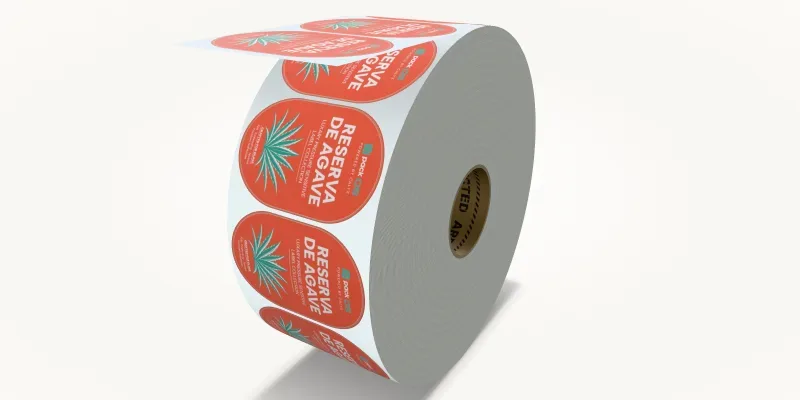
The same label in gloss, matte and soft touch
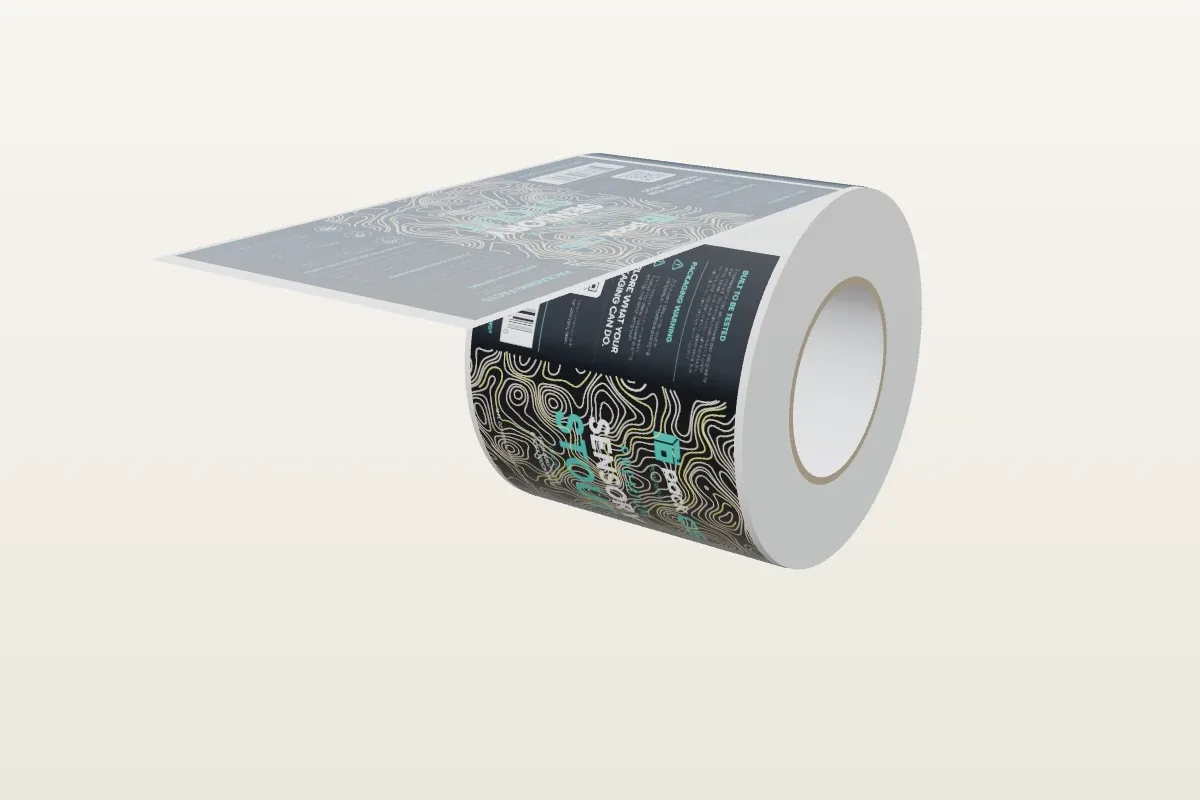
Gloss laminate
A clear, shiny film over the print. Colors look deeper and the surface reflects light, so highlights run across the label as it turns. Fingerprints and scuffs show more than on matte.
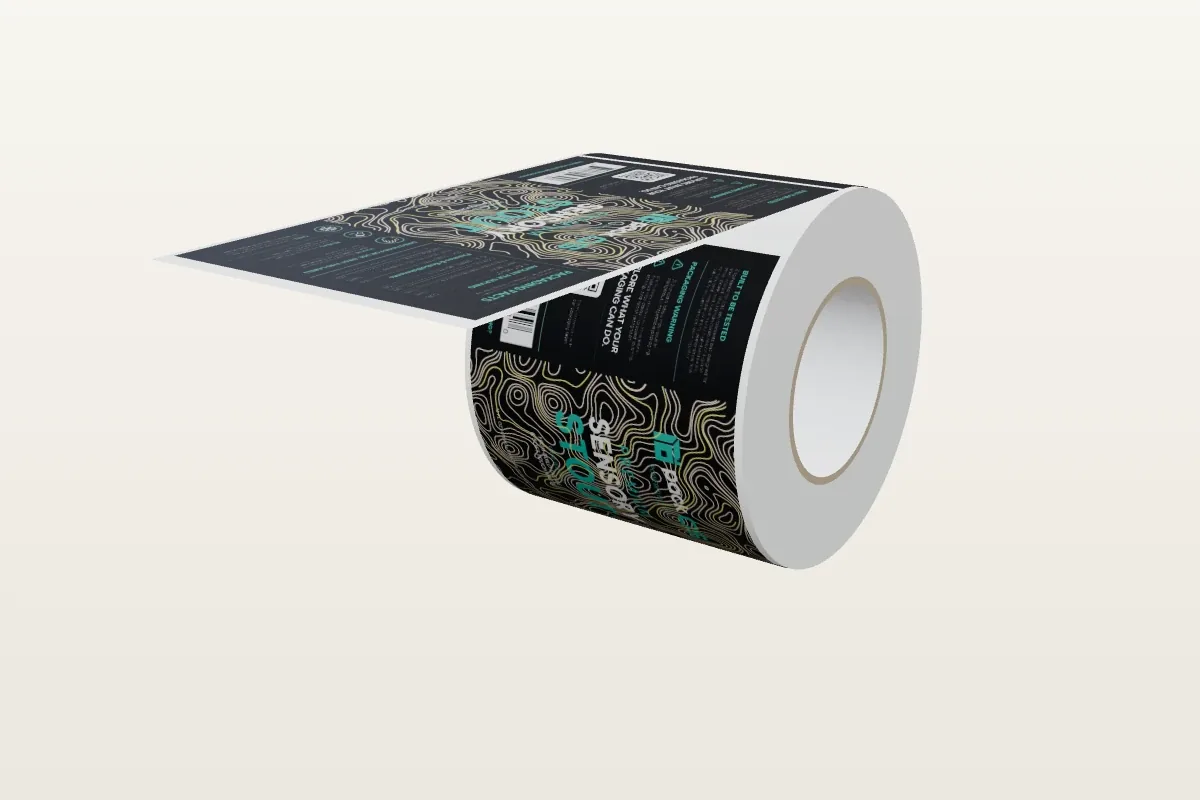
Matte laminate
A flat, non-reflective film. Softer color and no glare under shelf lighting. Often chosen for a premium, understated look.
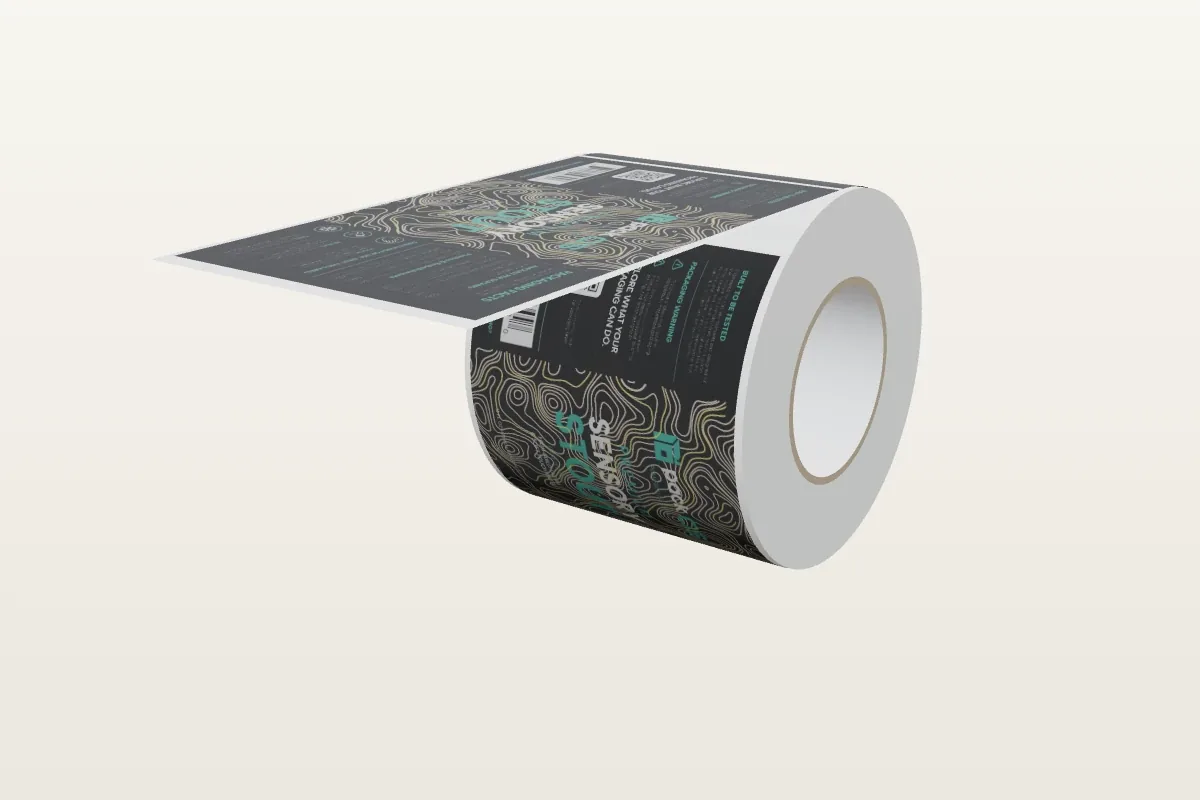
Soft-touch laminate
A velvet matte film with a suede feel in the hand. Muted and soft to the eye, and the finish people pick up to touch.
All three are priced instantly, as are spot UV and raised tactile varnish. Foil, embossing and debossing are quoted by our team.
Why start in PackOS
Once you have picked a finish, see the price, the dieline and your label on a roll in one place.
From file to price in PackOS
What you get in PackOS
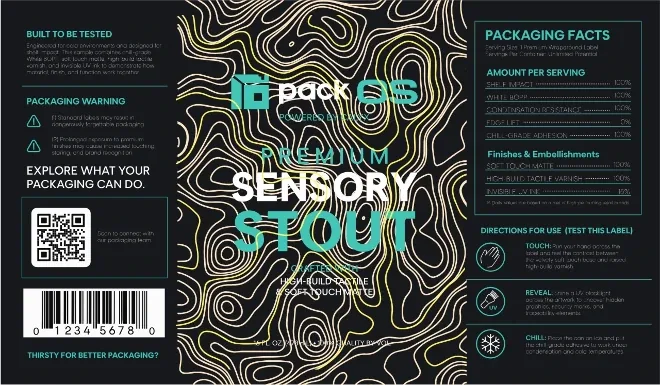
Skip the spec form
Upload a PDF or AI file and PackOS reads the size, shape, colors and finishes from your design. Nothing to retype.
Upload artwork →Instant price · sample label
| Run | Per label | Total |
|---|---|---|
| 10,000 | $0.1996 | $2,346 |
| 60,000 | $0.1692 | $10,500 |
| 110,000 | $0.1670 | $18,722 |
| 150,000 | $0.1663 | $25,290 |
| 200,000 | $0.1658 | $33,500 |
| 250,000 | $0.1655 | $41,725 |
Know the price before you ask
Every quantity is priced as soon as the file is read, with no waiting on a quote. Runs start at 10,000 labels per size with at least 2,500 per SKU. Your price depends on your artwork. Order online; the proof and a payment link follow by email.
Get instant label pricing →
Get a production dieline
No artwork yet? Draw the die with cut, bleed and safe-area lines so your designer starts from the right shape. We email it with your quote.
Create a label dieline →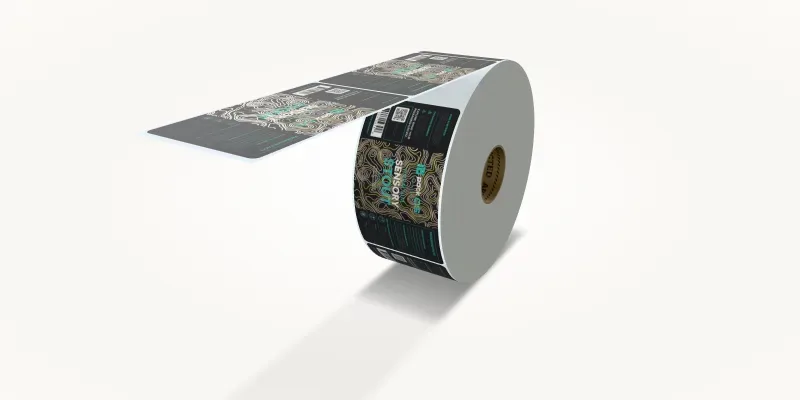
See it on the roll first
Turn your label on a 3D roll in the copy position you choose and check it before you order.
Upload artwork →Labels only. Foil, embossing and other specialty work are quoted by our team.
Start with two approval questions
Does it look right? Review sheen, color, reflective effects, texture and readability. Does it work in use? Review the required handling, product contact, moisture, application and coding conditions. Record the answers separately: an attractive sample is not a durability result.
For an enterprise program, keep the approved physical sample tied to a SKU and artwork revision. When several suppliers or production sites are involved, give each the same reference and acceptance criteria. A written request for “premium matte” leaves too much interpretation.
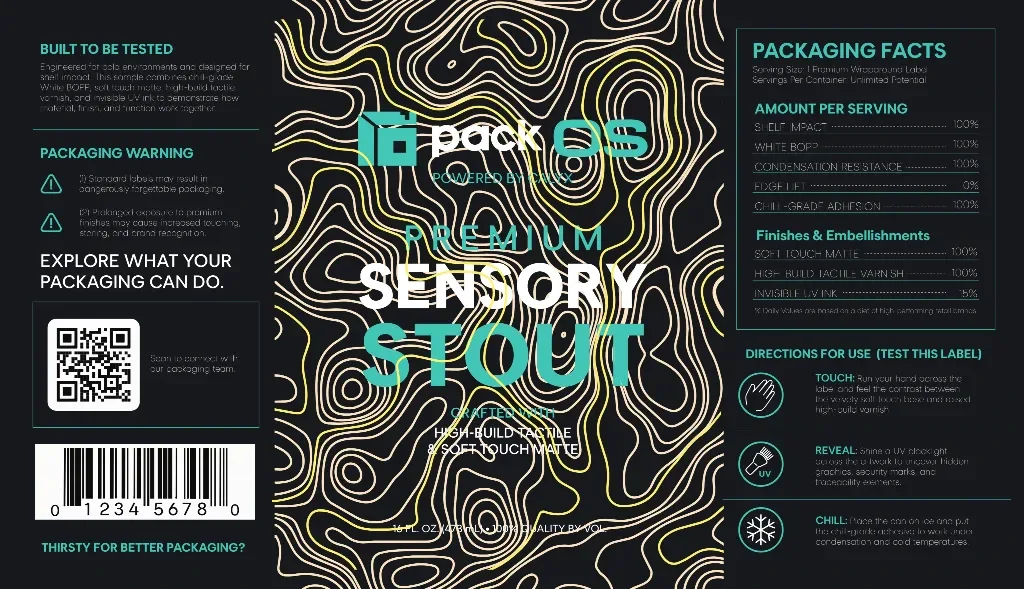
Raised tactile varnish
Add a finish you can feel
The Sensory Stout label has a raised tactile varnish on its contour lines. Raised varnish and spot UV price instantly with a gloss, matte or soft-touch laminate.
See it on the sample label →Compare matte, gloss, laminate, varnish and foil
| Option | What to specify | What to review |
|---|---|---|
| Gloss or matte laminate | Exact film and bonding system, coverage and intended sheen | Color and glare, surface marks, edge behavior and exposure evidence. |
| Gloss or matte varnish | Exact coating, print process and coverage | Appearance, compatibility and resistance for the proposed formulation. |
| Soft-touch finish | Whether the proposed effect is a film or coating; exact reference | Tactile feel and changes after the required handling sequence. |
| Spot coating / spot UV | Artwork separation, effect and permitted registration variation | Alignment, contrast, fine detail and compatibility with underlying layers. |
| Foil / transfer effect | Process, effect reference, artwork areas and production sequence | Appearance on the actual surface, detail, registration and quoted setup. |
| Embossing / debossing | Raised or recessed design, tooling and construction | Physical relief, artwork alignment and handling on the finished label. |
Lamination adds a film layer; varnish applies a coating. Products within each family differ. Sun Chemical describes overprint varnishes engineered for particular digital-print applications, including durability requirements. That is a reason to ask for the specific system, not to assume varnish is only decorative. SunEvo coating portfolio
For matte versus gloss, place samples with the same artwork side by side under agreed lighting. Tilt the intended filled container, read small text and inspect dark areas after handling. Decide what the brand accepts; do not infer equal protection from a shared finish family.
Define the exposure before comparing protection
Replace “durable” with a requirement the supplier can evaluate. Identify the substance or contact, duration, temperature, conditioning and observation criteria. Agree a suitable method and sample count with the responsible quality team before testing.
| Exposure to define | Observe separately |
|---|---|
| Case rubbing or repeated handling | Scuffs, gloss change, lost print and readability. |
| Condensation, splashes or immersion | Face appearance, exposed edges and attachment to the container. |
| Oil, cleaner or the packaged product | Changes to print, coating, foil and adhesion after the specified contact. |
| Squeeze, flex or application | Wrinkles, lifting, delamination and dispensing behavior. |
| Light or outdoor exposure | Color change and legibility over the required exposure, using agreed evidence. |
A laminate does not qualify the entire construction for water or chemical exposure. A face can remain readable while an edge lifts, or stay attached while the graphics change.
Use the material guide and adhesive guide to keep those decisions connected.
Have your artwork? See the price for every quantity in seconds.
Get instant label pricing →Map combined finishes in the artwork
SUPPLY AND CONFIRM
- An annotated visual reference plus the separations requested by the printer
- Full-area coatings, foil, spot effects and areas reserved for later printing, identified
- Process sequence and any required exclusions, trapping or minimum feature sizes, confirmed by the converter
DON'T
- Invent tolerances from a screen preview
- Assume hot stamping or cold transfer is always finer, faster or cheaper
Hot stamping and cold transfer are different process families. KURZ describes hot stamping with tooling and heat/pressure; its cold-transfer guidance distinguishes sheet-fed and web-fed systems. Choose from supported processes for the job. Hot stamping · Cold transfer
For file preparation, use the label artwork setup guide. Confirm the finished sample matches the quoted construction and artwork revision before accepting the visual effect.
Review the complete label on its container
A finish sample on a different stock or print system can communicate intent without representing the proposed order. Ask what differs from production. Include the face stock, adhesive, liner, ink system, finish and container in the approval record.
- Textured paper: assess how the proposed finish changes the feel and appearance.
- Clear labels: inspect transparency and white-ink areas on the filled container.
- Squeeze applications: assess the finished construction while the container deforms.
- Lot-code and date-code areas: keep them explicit. Test the actual coding equipment, ink or ribbon on the finished surface and review the result after the intended exposure.
These checks cannot be replaced by a material name. A finish-free zone, if needed, must be agreed with the converter rather than improvised after printing.
Have the artwork and quantities ready? Start the quote from the file, then review the detected attributes and confirm the available specification choices.
Upload artwork for an instant quote →No file yet?
Open a sample label in PackOS
Load the Sensory Stout sample to see the price, the dieline and the label on a 3D roll before you upload your own.
Open the sample label →Download the finish sample approval worksheet
Download the finish sample approval worksheet (CSV)
This editable record keeps appearance and service evidence together. It contains two clearly marked hypothetical candidate rows and one blank entry row. Delete the example rows before use; they are not tested constructions or recommended finishes. No completed records are sent to packOS by downloading it.
- IdentifyEnter the SKU, artwork revision, construction and finish references, artwork area and physical sample ID.
- CompareIdentify the approved reference, viewing conditions and appearance criteria. Record observations without turning a preference into a performance claim.
- QualifyReference the agreed exposure method and conditions, results, application check and variable-data check. Link detailed reports in your internal record if needed.
- DecideRecord open questions, decision, reviewer and date. Keep missing evidence visible; leave the candidate unreviewed until the responsible team decides.
Example use: two candidate matte finishes can match visually but have different unresolved coding or handling requirements. Record the appearance comparison, keep the missing checks open and request evidence before production release. The worksheet organizes that decision; it does not itself approve an order.
Compare the complete quoted finishing scope
Ask each supplier to separate recurring production costs from setup, plates, tooling, sampling and other first-order charges. Confirm what can be reused on a reorder and what changes when the artwork, dimensions or effect changes. Request lead-time assumptions for the actual production route.
Hold quantity by SKU, dimensions, construction and acceptance requirements constant when comparing alternatives. “Matte laminate” versus “matte varnish” may change more than price. Record the proposed substitution and required approval work. Use the label cost guide for a fuller quote comparison.
Consider no added finish as a candidate
An uncoated appearance may be intentional. Ask the supplier whether the printed construction without an added finish meets the actual brief, then evaluate it against the same requirements. Short product life alone does not establish acceptable handling or legibility.
If recyclability or another environmental requirement influences the choice, request evidence for the complete decorated package in its intended market. Adding or omitting a film does not, by itself, prove an environmental outcome.
Instant label pricing
Upload your artwork and see the price
Drop in a PDF or AI file. PackOS reads the size, shape and colors and prices it from 10,000 labels per size.
Upload artwork →Carry the approved finish into the label order
Keep the finish reference, artwork map, sample ID and approval decision with the order. For multi-SKU programs, identify exactly which items the approval covers. Review any changed stock, ink, finish or production process before treating a reorder as equivalent.
Start a packOS custom roll-label quote with the artwork and quantities, then review the detected attributes and confirm the available specification choices. The processes discussed here are buying context; confirm availability and requirements outside the quote options with the team. See the custom roll-label buying page for order preparation.
Frequently asked questions
What is the difference between matte and gloss labels?
Matte and gloss describe the surface appearance. Compare representative printed samples under agreed lighting and on the intended container. Review color, reflected glare, legibility and handling marks. Neither appearance term establishes the durability of the particular finish.
Is lamination better than varnish for labels?
There is no universal ranking. Lamination adds a film layer; varnish is a coating system. Ask which specific product and process meet the required appearance, exposure and application conditions. Compare evidence for the finished construction rather than assuming every laminate outperforms every varnish.
Does a laminated label become waterproof?
Lamination alone does not qualify the whole label for water exposure. Define the water, temperature, duration and handling involved, then assess print appearance, edges, face stock and adhesion on the intended container. Record the actual construction and acceptance criteria.
What is spot UV on a label?
Spot UV is a UV-cured coating applied to selected artwork areas. Specify the intended effect and provide a separate artwork reference following the printer’s instructions. Confirm registration, compatibility and physical appearance in the proposed production process.
How do hot foil and cold foil differ?
Hot stamping uses heat, pressure and tooling to transfer an effect. Cold transfer uses a process-specific adhesive system. Ask the converter which process suits the artwork and construction, then compare samples, setup charges and production assumptions. Neither process name proves a universal quality or cost advantage.
Should soft-touch labels be tested for scuffing?
Yes, when handling marks or surface changes matter to the brief. Use representative printed samples and an agreed handling or abrasion method. Record the exact finish, exposure and appearance criteria; a tactile description does not establish scuff resistance.
Can I print lot codes over a label finish?
Confirm compatibility with the actual coding equipment, ink or ribbon and finished surface. Identify the coding area in the artwork and assess legibility and resistance after the required exposure. If a finish-free area is proposed, confirm its placement and production tolerances.
What should a finish approval record include?
Include the SKU, artwork revision, construction and finish references, artwork areas, physical sample ID and approved reference. Record appearance observations, exposure method and results, application and coding checks, open questions, decision, reviewer and date. Keep untested candidates marked as unreviewed.